What is 11+ verbal reasoning?
Verbal reasoning tests how well your child can think and solve problems with words: spotting synonyms and opposites, finding links between words and cracking letter codes. English comprehension tests understanding of a passage; verbal reasoning tests logical thinking with words.
How much it counts depends on your area. In Buckinghamshire's Secondary Transfer Test, for example, verbal skills make up 50% of the standardised score, with mathematical and non-verbal skills at 25% each (Buckinghamshire Council, page updated 9 April 2026). Check your own council's or school's 11+ information for the format of your test.
Key success factor
A strong vocabulary underpins almost every verbal reasoning question type. The 11+ Vocab Master app has 2,500+ words for the 11+ in 100 categories, with synonym, antonym and definition practice. You can also print our free 11 plus vocabulary list with meanings or try the free 11+ vocabulary quiz.
Source: Buckinghamshire Council, Marking the Secondary Transfer Test (page updated 9 April 2026; checked 12 October 2026). App figures: 11 Plus Apps.
Common verbal reasoning question types
1. Synonyms (similar words)
Select the word most similar in meaning to the given word.
Example: HAPPY
A) Sad B) Joyful C) Angry D) Tired
✓ Answer: B) Joyful
How 11+ Vocab Master helps
Use the app's synonym practice, then use new words in a sentence of your own so the meaning sticks.
2. Antonyms (opposite words)
Find the word most opposite in meaning to the given word.
Example: DIFFICULT
A) Hard B) Complex C) Easy D) Tricky
✓ Answer: C) Easy
How 11+ Vocab Master helps
Learn each new word with its opposite. The app's antonym practice and games make opposites quick to revise.
3. Word analogies
Identify the relationship between word pairs and apply it to complete another pair.
Example: HOT is to COLD as UP is to ___
A) High B) Down C) Over D) Top
✓ Answer: B) Down (opposites)
How 11+ Vocab Master helps
Practising word relationships (synonyms, antonyms and categories) in the app helps with analogy questions.
4. Odd one out
Identify which word doesn't belong with the others.
Example: Which word is the odd one out?
A) Apple B) Banana C) Carrot D) Orange
✓ Answer: C) Carrot (it is a vegetable; the others are fruits)
5. Letter and number codes
Decode words using a given letter-to-number pattern.
Example: If CAT = 3-1-20, what is DOG?
A) 4-15-7 B) 4-12-7 C) 3-14-6 D) 5-16-8
✓ Answer: A) 4-15-7
Verbal reasoning in different 11+ tests
Every area sets its own 11+ test, so the share of verbal reasoning and the question types vary. Some tests have a separate verbal reasoning section; others mix word questions in with English. Your council's or school's 11+ pages, and any familiarisation booklet they publish, are the best guide to your child's test.
| Skill | Share of the standardised score |
|---|---|
| Verbal skills | 50% |
| Mathematical skills | 25% |
| Non-verbal skills | 25% |
Source: Buckinghamshire Council, Marking the Secondary Transfer Test (page updated 9 April 2026; checked 12 October 2026).
Whatever the format, vocabulary is the common thread. Our guide to building 11+ vocabulary has a simple daily routine and word games to play at home.
2,500+ words
2,500+ words for the 11+ in 100 categories, with 12,000+ vocabulary questions.
7 fun games
7 games and 6 practice modes turn vocabulary practice into play.
My Difficult Words
A list of the words your child finds hard, so practice goes where it's needed.
Unlimited mock tests
Unlimited vocabulary mock tests for exam-style practice.
Track your progress
Progress tracking shows how your child is getting on over time.
Learn anywhere
iPhone, iPad and Android apps that work offline and are ad-free, with audio pronunciation.
Download 11+ Vocab Master
7-Day Free Trial • Available on iOS & Android
Then £3.99/month • 6 months £9.99 • 1 year £12.99
Practise every question type with 11+ Verbal Reasoning Master
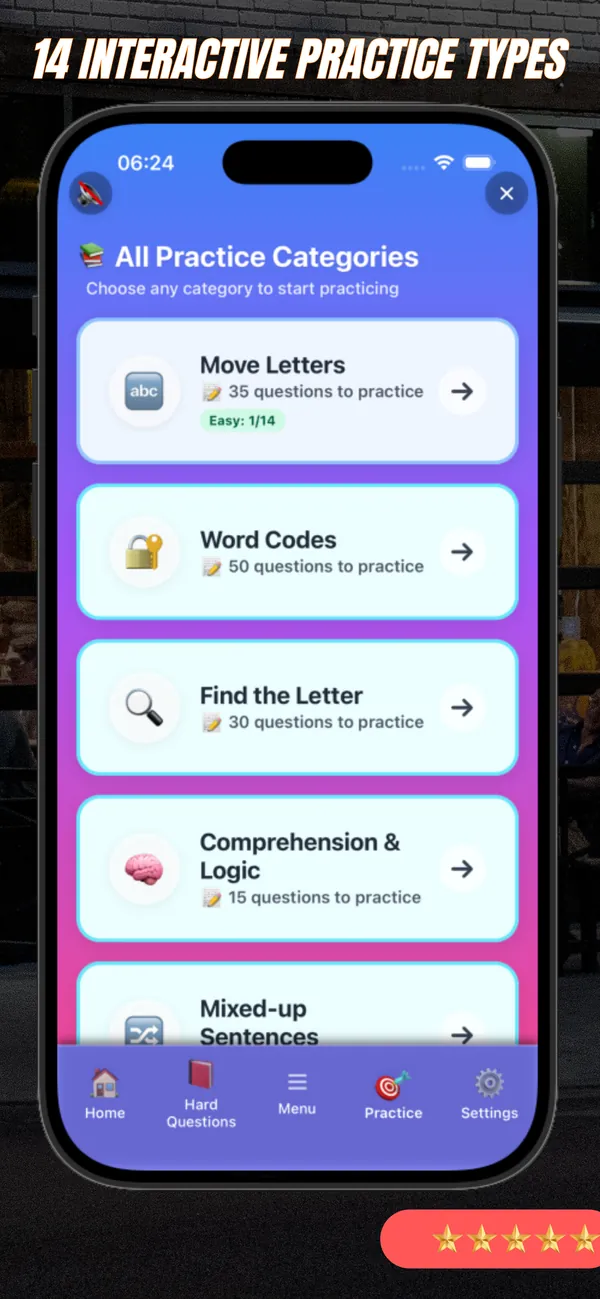
Vocabulary is the base; question-type practice is the next step. 11+ Verbal Reasoning Master has 2,000+ verbal reasoning questions covering 38+ question types, with 6+ practice modes, flashcards for every question type, mock tests and five VR games (such as Analogy Arena and Code Cracker).
It has a 7-day free trial, then £3.99 a month, £9.99 for 6 months or £14.99 a year.
11+ Verbal Reasoning Master
Effective study strategies
Build from words to question types to timed practice, in that order.
- Build vocabulary
A few new words a day, with their meanings, synonyms and opposites.
- Learn each question type
Work through one type at a time until the method is automatic.
- Mix the types
Practise mixed sets so your child spots the type quickly.
- Add timed practice
Closer to the test, practise against the clock and review mistakes.
Daily vocabulary practice
Spend 15–20 minutes a day on new words, on paper or with 11+ Vocab Master. Little and often works better than cramming.
Tip: Keep a list of tricky words (the app has a My Difficult Words list) and revisit it each week.
Make it fun with games
Short games keep practice light: try same-or-opposite or odd one out in the car, or the games in the apps.
Tip: set a friendly challenge. Can your child beat yesterday's score?
Practise each question type
Don't just learn words: practise using them in each question type. Timed practice closer to the test shows up weak areas.
Tip: In the final months, a weekly timed test helps track progress.
Read widely
Reading widely (stories, non-fiction and newspapers for children) shows words in context.
Tip: When your child meets a new word, look it up together and add it to their word list.
What to do in Years 3, 4, 5 and 6
Vocabulary comes first; verbal reasoning question types come later.
| School year | Focus | Using our apps |
|---|---|---|
| Year 3 | Reading for pleasure and light word games. | A few minutes of the Vocab Master games, with audio pronunciation. |
| Year 4 | A daily word habit: synonyms and opposites. | Short Vocab Master sessions through the categories. |
| Year 5 | Learn each question type; start exam-style practice. | VR Master practice modes and flashcards; Vocab Master mock tests and progress tracking. |
| Year 6 | Mixed and timed practice; rest before the test. | Mock tests in both apps; Vocab Master works offline. |
Exam-day tips
Time management
- • Don't spend too long on any one question
- • Skip difficult questions and return later
- • Keep an eye on the clock
- • Practise timed tests beforehand
Answer strategies
- • Read questions carefully, twice if needed
- • Eliminate obviously wrong answers first
- • Use the other words in the question as clues
- • Check answers if time permits
Stay calm
- • Deep breaths if feeling stressed
- • Don't panic over unknown words
- • Use word parts (prefixes/suffixes) as clues
- • Remember your preparation.
Mark your answers
- • Fill answer bubbles completely
- • Erase mistakes thoroughly
- • Transfer answers carefully if using rough paper
- • Double-check question numbers
Once the test is over, our guide to 11+ results day 2026 and what your score means explains standardised scores and your next steps. If the score falls short, our guide to your options if your child didn't pass the 11+ covers reviews, appeals and waiting lists.
Build verbal reasoning vocabulary with 11+ Vocab Master
Built for children preparing for the 11+
2,500+ words
For the 11+
Synonyms & Antonyms
Master relationships
7 fun games
Engaging practice
Mock tests
Unlimited vocabulary mock tests
7-Day Free Trial • Then £3.99/month • 6 months £9.99 • 1 year £12.99
Frequently asked questions
What is 11+ verbal reasoning?
Verbal reasoning tests how well a child can think and solve problems with words, rather than how well they read a passage. Typical questions ask for synonyms, antonyms, analogies, odd ones out and letter or number codes. A strong vocabulary underpins almost every question type.
Is verbal reasoning the same in every 11+ test?
No. Each area sets its own test, so the share of verbal reasoning and the question types vary. In Buckinghamshire's Secondary Transfer Test, for example, verbal skills make up 50% of the standardised score. Check your council's or school's 11+ information and any familiarisation materials for your child's test.
How can my child get better at verbal reasoning?
Build vocabulary every day for 15–20 minutes, then practise each question type until the method is automatic. Add timed practice tests closer to the exam, and keep a list of words and question types your child finds hard so you can revisit them.
Related 11+ resources
Mastering vocabulary
Essential strategies for 11+ vocabulary success
100 words with synonyms
Practise synonym relationships for verbal reasoning
100 words with antonyms
Master opposites for verbal reasoning questions
Ready to practise verbal reasoning?
Download 11+ Vocab Master and start your 7-day free trial
Download Now