

The best way to build 11+ vocabulary is a little every day: wide reading, a handful of new words each week, and short reviews so the words stick. Start gently in Year 3 or Year 4, build steadily through Year 5, and use Year 6 for revision rather than cramming.
This guide is the hub for everything on our site about 11+ vocabulary. It explains why words matter so much, gives you a routine you can actually keep up, shows what to focus on in each school year, and points you to our free word lists.
Sources: Buckinghamshire Council, Medway Council (checked 4 October 2026).
Why does vocabulary matter so much for the 11+?
Vocabulary feeds almost every part of the 11+: verbal reasoning, comprehension, and writing all depend on knowing what words mean. A child who meets 'meticulous' or 'reluctant' in a passage and already knows them reads faster and answers with more confidence.
In some areas the weighting is spelled out. Buckinghamshire builds its Secondary Transfer Test Score from three skill areas across two papers, and verbal skills count for half of it.
Other areas use different tests and weightings, so check your own council or grammar school. The principle holds everywhere, though: the questions use words, and a bigger vocabulary means fewer questions that feel like guesswork.
Words show up in these question types most often:
- Synonyms and antonyms: pick the word closest in meaning, or opposite in meaning.
- Odd one out and related words: spot which words belong together.
- Cloze passages: choose the word that fits a gap in a sentence.
- Comprehension: explain what a word means in the passage, or why the writer chose it.
- Creative writing: precise, varied words lift a story above the rest.
Our 11+ verbal reasoning guide walks through the question types, and the 11+ English guide covers comprehension and writing.
How many words does my child need to know?
No number of words guarantees a pass. We know of no official 11+ word list published by the test providers, and every year's paper is different.
A better aim is steady growth: a handful of new words each week that your child can read, explain and use, plus regular review of older words. Five new words a week over two school years of about 40 weeks each comes to around 400 words, on top of everything your child picks up from reading.
Knowing 300 words well beats recognising 3,000 words vaguely. A word only counts when your child can explain it, give a synonym and use it in a sentence.
How to build 11+ vocabulary: six habits that work
Mix reading, word study and short reviews; no single method is enough on its own. These six habits fit around school and clubs.
- Read every day
Fiction, non-fiction, newspapers for children and classics. Twenty minutes before bed counts. Read aloud together sometimes, even with older children.
- Go word hunting
Ask your child to note two or three new words per chapter, guess the meaning from the sentence, then check it.
- Learn words in families
Learn 'generous' with 'charitable' and 'mean'. Synonyms and antonyms together are easier to remember than single definitions.
- Break words apart
Prefixes, roots and suffixes unlock new words: 'un-', 'bene-', '-ful'. One root can explain a dozen words.
- Use the words
Drop new words into conversation and writing. Ask your child to describe dinner as 'delectable' or a sibling as 'boisterous'.
- Review little and often
Ten minutes a day, revisiting older words as well as new ones, keeps words from fading. Games make this feel less like homework.
For word families, our guide to 11+ synonyms and opposites groups 50 key words with their synonyms and antonyms.
Word roots: one small idea, dozens of words
Learning a few common roots lets your child work out unfamiliar words in the test. Many English words are built from Latin and Greek parts, and the same part usually keeps its meaning across words.
| Root | Meaning | Example words |
|---|---|---|
| bene | good, well | benefit, benevolent, beneficial |
| mal | bad, badly | malicious, malfunction, malnourished |
| spect | look | inspect, spectator, spectacles |
| port | carry | transport, portable, import |
| dict | say | predict, dictate, contradict |
| aud | hear | audible, audience, audition |
| chron | time | chronological, chronicle, synchronise |
| graph | write, draw | autograph, paragraph, photograph |
Try it at the dinner table: if 'aud' means hear, what might 'inaudible' mean? Prefixes work the same way. 'In-', 'un-' and 'dis-' often mean 'not' (though 'in-' can also mean 'into', as in 'import'), which is handy for antonym questions: 'inaudible' is the opposite of 'audible', and 'dishonest' of 'honest'.
A weekly vocabulary routine (about 15 minutes a day)
Short, regular sessions are easier to keep up than long weekend ones. Here is a routine many families can fit around school. Swap days around as you need to.
| Day | Activity | Time |
|---|---|---|
| Monday | Learn 5 new words: meaning, a synonym, an antonym, a sentence | 15 mins |
| Tuesday | Synonym and antonym practice on this week's and last week's words | 15 mins |
| Wednesday | Word games (app, board game or a car-journey quiz) | 15 mins |
| Thursday | Quick quiz on this week's words, plus a review of older ones | 15 mins |
| Friday | Use the week's words in a short paragraph or story | 15 mins |
| Weekend | Reading for pleasure; a mock test every few weeks in Year 5 | 20–30 mins |
Keep a 'word wall' on the fridge. Add each new word on a sticky note and move it to a 'mastered' column when your child uses it correctly without help.
Has my child really learned a word? A five-point check
Recognising a word isn't the same as knowing it. Before you move a word to the 'mastered' pile, check that your child can do all five of these without help:
- Explain it in their own words, not a memorised definition.
- Give a synonym: 'reluctant' means about the same as 'unwilling'.
- Give an antonym: the opposite of 'reluctant' is 'eager'.
- Use it in a sentence that shows the meaning: 'The reluctant puppy dug in its paws at the vet's door.'
- Spell it correctly, because spelling is tested in some English papers.
Words that fail one of the checks go back into the weekly review. That's normal: most words need several meetings before they stick.
What to do in Year 3, 4, 5 and 6
Vocabulary grows slowly and can't be crammed, so the earlier years are the time to build it. This is a sensible pace for most families; adjust it to your child. For more detail on each year, see our Year 3 11 plus preparation guide, Year 4 11 plus preparation without the pressure and the Year 5 11+ preparation plan, term by term.
| School year | Focus | Using 11+ Vocab Master |
|---|---|---|
| Year 3 | Reading for pleasure every day and talking about new words (our Year 3 reading list has ideas). No tests, no pressure. | A few minutes of the games a couple of times a week, with audio pronunciation. |
| Year 4 | A regular word habit: a handful of new words each week, plus synonyms and opposites for words your child already knows (our Year 4 reading list has book ideas). | Short daily sessions working through the categories, mixing practice modes and games. |
| Year 5 | Steady, structured practice: harder words, exam-style synonym and antonym questions, and verbal reasoning (our Year 5 reading list has book ideas). | Daily practice plus regular mock tests, with progress tracking to see which words need another look. |
| Year 6 (before the test) | Revision rather than lots of new words, timed practice, and rest in the final weeks. | Unlimited mock tests to rehearse. It works offline, so it fits into car journeys. |
| Year 6 (after the test) | Keep reading. A wide vocabulary helps in every subject at secondary school. | Optional: a few words a week keeps the habit going. |
If your child has just sat the test, our guide to 11+ results day 2026 explains what the scores mean and what to do next.
Free 11+ word lists to start with
Pick one list, work through it a few words at a time, and only move on when the words feel easy. Each of these is free on our site.
Vocabulary games for the car and the kitchen
Games turn review into something children ask for. These need no equipment and work in five spare minutes.
Synonym tennis
- Say a word, such as 'big'.
- Take turns giving synonyms: huge, vast, enormous, colossal.
- The first person stuck loses the point.
Opposites snap
- Call out a word, such as 'generous'.
- First to shout a correct antonym ('mean', 'stingy') wins.
- Harder words score double.
Word of the day
- Pick one word at breakfast.
- Everyone tries to use it naturally before bedtime.
- Award a point for each correct use.
For more structured practice, our free 100-word synonyms list gives you plenty of words to play with, and our vocabulary games for 11 plus guide has eight more games with worked examples.
Common mistakes to avoid
Most vocabulary problems come from going too fast or learning words in isolation. Watch out for these:
Long lists learned the week before the test rarely stick. Words need to be met several times, in different places, before your child owns them.
- Definitions only: a word learned without a sentence is quickly forgotten. Always add an example.
- Never looking back: new words every day with no review means last month's words fade.
- Skipping reading: lists help, but reading is where children meet words in context, the way the test presents them.
- Making it a chore: short sessions, games and praise keep children coming back. Stop while it's still fun.
How 11+ Vocab Master helps
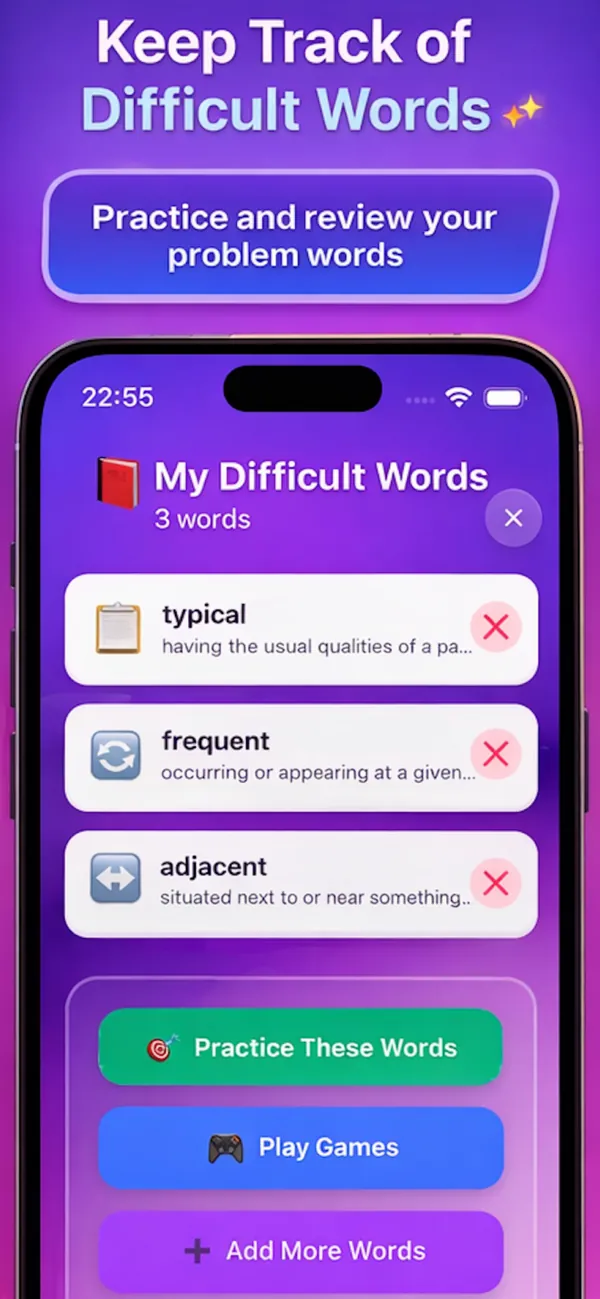
If you'd like a ready-made daily routine, 11+ Vocab Master puts the habits above into one app.
- 2,500+ words for CEM-style and GL Assessment tests, organised into 100 categories.
- 6 practice modes and 7 games for daily review, with audio pronunciation.
- Unlimited mock tests and progress tracking, so you can see which words need another look. It works offline and is ad-free.
It comes with a 7-day free trial, then £3.99 a month, £9.99 for 6 months or £12.99 a year.
Sources
Checked on 4 October 2026. Test formats differ by area, so always check your own council or grammar school.
- Marking the Secondary Transfer Test, Buckinghamshire Council
- Timeline for entry in 2027, Buckinghamshire Council
- Key dates for applying for secondary school, September 2027 entry, Medway Council