The 11+ NVR (non-verbal reasoning) test checks how well your child spots patterns and rules in shapes and diagrams, with no words or sums involved. Many children improve quickly once they know the main question types and learn a simple checklist for each puzzle.
This guide explains what the NVR test involves, walks through six original example questions with answers, and gives you a practice plan from Year 3 to Year 6.
Sources: Marking the Secondary Transfer Test and Secondary Transfer Testing process, Buckinghamshire Council (checked 4 October 2026). Formats differ by area.
What is the 11+ NVR test?
Non-verbal reasoning (NVR) questions show a set of shapes and ask your child to find the rule that links them. The rule might be a turn, a change of size, a shading pattern, or a count of sides, lines or dots. Your child then uses that rule to pick the missing or odd shape.
Spatial reasoning is a closely related skill that some tests include under non-verbal skills: picturing shapes being turned, reflected or folded in your head. In Buckinghamshire's test, non-verbal skills including spatial reasoning sit in the same paper as maths, and every question is multiple choice.
Not every area tests NVR in the same way, and some areas use different test providers, so check your own council or grammar school. The good news is that the core question types below turn up again and again.
NVR is less about knowledge and more about method. A child who checks shapes in the same order every time makes far fewer careless mistakes.
The main NVR question types
Most NVR papers are built from a small set of question types. Learn to recognise each one and you already know half the method.
| Question type | What your child sees | What to look for |
|---|---|---|
| Series | A row of shapes with the next one missing | Turning, moving, adding or removing parts step by step |
| Analogies | 'This is to that, as this is to ?' | The exact change in the first pair: size, shading, turn, flip |
| Odd one out | Five shapes, one breaks the rule | Number of sides, lines, dots, right angles; symmetry |
| Matrices | A grid with one square missing | A rule across rows and a rule down columns |
| Reflections and rotations | A shape and a mirror line, or a shape to turn | Which side each detail ends up on |
| Codes | Shapes with letter codes, one code missing | Which letter matches which feature (shape, size, shading) |
| Nets and cubes | A flat net and some folded cubes | Which faces end up opposite or next to each other |
The word-based papers are covered in our 11+ verbal reasoning guide.
Try six NVR example questions
These are original practice questions in the style of the 11+ NVR test, with answers. Let your child try each one before opening the answer, then talk through the rule together.
Question 1: Which arrow comes next?
Look at how the arrow changes from box to box. Which option, A to D, should replace the question mark?
Show the answer
Answer: C. The arrow turns a quarter turn (90 degrees) clockwise each time: up, right, down. The next quarter turn points it left. B and D repeat earlier steps, and A points up again, like the first box.
Question 2: Complete the pair
The first shape changes into the second. Apply the same change to the third shape. Which option replaces the question mark?
Show the answer
Answer: D. In the first pair the shape keeps its outline but becomes small and white. The square does the same, so the answer is a small white square. A is white but still big, B is small but still shaded, and C changed the shape.
Question 3: Which shape is the odd one out?
Four of these shapes follow the same rule. Which one does not?
Show the answer
Answer: C. Each shape holds as many dots as it has sides: the triangle has 3, the squares 4, the pentagon 5. The hexagon has 6 sides but only 5 dots. Counting sides and dots is a classic hidden rule.
Question 4: Which shape completes the grid?
Find the rule that works across the top row, then use it on the bottom row.
Show the answer
Answer: A. Across each row, the right-hand box is the left-hand shape with a horizontal line through it. The bottom row starts with a triangle, so the answer is a triangle with a horizontal line. D adds an extra vertical line.
Question 5: Which option shows the reflection?
Which option shows the shape on the left reflected in the dashed mirror line?
Show the answer
Answer: C. A mirror line down the side flips the shape left to right: the flag now points left and the small square sits on the other side of the pole. B is flipped upside down, D is turned halfway round, and A has not changed.
Question 6: Which code goes with the small square?
Each shape has a two-letter code. Work out what each letter stands for, then choose the code for the small square.
Show the answer
Answer: B. Compare shapes that share a letter. Both circles end in X and the square ends in Y, so the second letter means the shape. Both large shapes start with A and the small circle starts with B, so the first letter means size. Small square = B then Y.
A six-point checklist for any NVR question
When the rule isn't obvious, check these features in the same order every time. Most questions are solved by one or two of them.
- Shape: is the outline the same, or does it change?
- Size: do shapes get bigger, smaller, or swap sizes?
- Shading: black, white, striped or dotted, and does it move?
- Number: count sides, lines, dots, right angles and separate parts.
- Position: do parts move round the box or swap places?
- Turns and flips: is it rotated (clockwise or anticlockwise) or reflected?
Rule out answers as well as looking for the right one. If two features are already wrong in an option, cross it off and move on.
How to practise NVR at home
Build accuracy first, then speed. These six steps take most families from first look to test-ready.
- Learn the types
Go through each question type with worked examples like the ones above, untimed.
- Use the checklist
Say the six checks out loud for a week until they become a habit.
- Short daily sets
Ten to fifteen questions a day is easier to keep up than one long session at the weekend.
- Review every mistake
Ask which feature was missed. The same few features cause most errors.
- Add timing
Once accuracy is good, practise against the clock in short timed sets.
- Use official practice
Buckinghamshire offers a familiarisation booklet and points to free GL Assessment materials.
Everyday play helps too. Jigsaws, tangrams, building bricks, origami and drawing a toy from different sides all train the same 'picture it in your head' skill, and children rarely see them as work.
What to do in Year 3, 4, 5 and 6
Start with play, move to method, then add timing. Keep building vocabulary alongside NVR: in Buckinghamshire, for example, verbal skills count for 50% of the score.
| School year | NVR focus | Vocabulary with 11+ Vocab Master |
|---|---|---|
| Year 3 | Shape games, jigsaws, tangrams and building toys. No tests. | A few minutes of the games a couple of times a week, with audio pronunciation. |
| Year 4 | Meet each question type with easy, untimed examples. | Short daily sessions working through the categories. |
| Year 5 | Daily short sets with the checklist; start timed practice later in the year. | Daily practice plus regular mock tests, with progress tracking. |
| Year 6 (before the test) | Timed mixed sets and familiarisation papers; rest before test day. | Unlimited mock tests to rehearse; works offline for car journeys. |
For a full vocabulary plan, see how to build 11+ vocabulary, year by year. If your child has just sat the test, our 11+ results day 2026 guide explains the scores.
Common NVR mistakes
Many lost marks come from rushing rather than from questions being too hard.
Picking the first option that 'looks right'. Often two options match the main rule and only one matches a second, smaller detail.
- Mixing up turns and flips: a reflection is not the same as a half turn. Question 5 above has both as options.
- Clockwise confusion: practise with a real clock face until it is automatic.
- Only checking one direction in grids: matrix rules can run across rows, down columns, or both.
- Losing time on one question: mark it, move on, and come back if there's time.
How our apps help with the rest of the test
We don't make an NVR app. Our apps cover the verbal side of the 11+, which sits alongside NVR in many tests.
- 11+ Verbal Reasoning Master: 2,000+ verbal reasoning questions covering 38+ question types, with flashcards, mock tests and games.
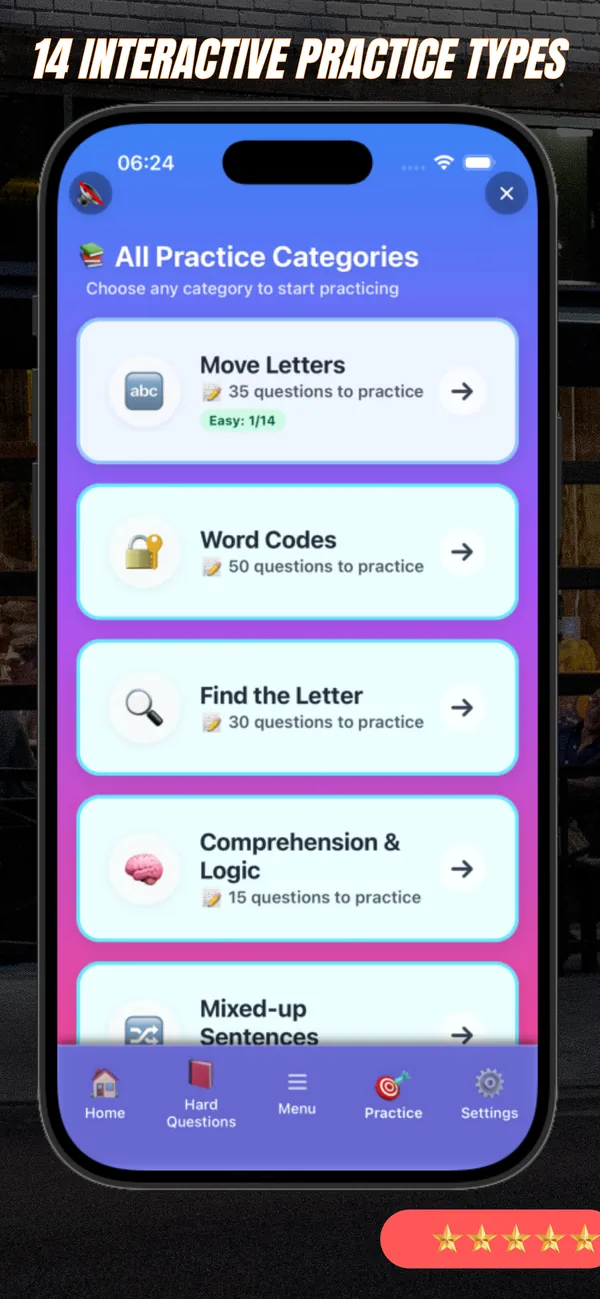
- 11+ Vocab Master: 2,500+ words for CEM-style and GL Assessment tests in 100 categories, with 6 practice modes and 7 games.
- Both come with a 7-day free trial. After that each is £3.99 a month or £9.99 for 6 months; a year costs £14.99 (VR Master) or £12.99 (Vocab Master).
11+ Verbal Reasoning Master
11+ Vocab Master
11+ NVR Test FAQs
What is the 11+ NVR test?
NVR stands for non-verbal reasoning. Questions show shapes and diagrams instead of words or numbers, and children find the rule that links them: a turn, a reflection, a change of size or shading, or a count of sides or dots. They then use the rule to choose the missing or odd shape.
Can you get better at non-verbal reasoning with practice?
Yes, most children improve with practice. Learning the main question types and a fixed checklist of features (shape, size, shading, number, position, turns and flips) cuts careless mistakes. Short daily sets work better than long sessions, and reviewing every wrong answer shows which feature your child tends to miss.
How long is the 11+ non-verbal reasoning paper?
It depends on your area. In Buckinghamshire there are two multiple-choice papers of about 45 minutes each, and non-verbal skills share a paper with maths. Other areas and test providers use different formats, so check your own council or grammar school's 11+ pages for the exact timings.
When should my child start practising NVR?
Many families start with shape games and puzzles in Year 3 or Year 4, introduce the question types gently in Year 4, and practise regularly through Year 5. Timed practice works best later in Year 5 and in the weeks before the test, once your child is accurate without a clock.
Sources
Checked on 4 October 2026. Test formats differ by area, so check your own council or grammar school.
- Secondary Transfer Testing process, Buckinghamshire Council
- Marking the Secondary Transfer Test, Buckinghamshire Council
All six example questions on this page are original and were written for 11plusapps.com.