If your child didn't pass the 11 plus, the grammar school route is not always closed. You can still name a grammar school on your application by 31 October 2026. Some areas run a local review before offers are made. You can appeal after National Offer Day on 1 March 2027, join waiting lists, and in some areas try again for a place in Year 8 or Year 9.
None of these routes is easy, and most children who miss the score go on to a non-grammar school. This guide sets out each option, what it needs from you, and the dates for September 2027 entry. Every date and rule comes from council and Department for Education pages we checked on 5 October 2026.
Sources: Buckinghamshire Council, Selection Review and GOV.UK, School admissions (checked 5 October 2026).
Whatever you decide about appeals, submit your secondary school application to your home council by 31 October 2026. Put the grammar school on it if you might appeal, and put schools you would be happy with on it too.
What "didn't pass the 11 plus" actually means
It means your child's score was below the standard your area uses to decide who is suitable for grammar school. It does not stop you applying. Each area words this differently, so check the exact wording on your child's results email.
- Buckinghamshire: a Secondary Transfer Test Score (STTS) below 121 means your child has not qualified for a Buckinghamshire grammar school. The council tells parents who want to go further to include their preferred grammar schools on the application anyway.
- Medway: children are assessed as suitable for grammar or non-grammar school. If your child was assessed as non-grammar, you can still apply for grammar schools, but the council will not offer one on National Offer Day. It recommends naming a mixture of grammar and non-grammar schools.
- Other areas: rules vary, and some schools rank children by score rather than using a pass mark. Your council's admissions pages and each school's admissions policy are the places to check.
GOV.UK says that listing only one school will not increase your chances of getting a place there. If your child is not offered any school on the list, the council must offer a place elsewhere, usually the nearest school with places left. Fill every preference with schools you would genuinely accept.
Your options at a glance
There are five main routes after a disappointing 11+ result, and they happen at different points in the year. Some you must start in October; others only open after offers arrive in March.
| Option | When | Where it applies |
|---|---|---|
| Local review (Selection Review) | Case due 30 October 2026; outcome 12 February 2027 | Buckinghamshire (some other areas have their own review) |
| Pupil Premium places | Evidence to the school by 31 October 2026 | All Buckinghamshire grammar schools, subject to each school's minimum score |
| Admission appeal | After offers on 1 March 2027 | Every school you named and were refused |
| Waiting list | From offer day; kept until at least 31 December 2027 | Any school, under the school's own rules |
| Entry after Year 7 | Buckinghamshire registration 5 to 23 October 2026, for September 2027 entry | Buckinghamshire late transfer (Year 8 and Year 9); elsewhere, ask the school |
- 30 October 2026
Buckinghamshire Selection Review case due in full
- 31 October 2026
Secondary school applications close: name every school you might appeal for
- 12 February 2027
Buckinghamshire Selection Review outcomes for cases heard November to January
- 1 March 2027
National Offer Day: refusal letters explain how to appeal
- 13 April 2027
Medway on-time appeal deadline
- May 2027 onwards
Buckinghamshire admission appeals are heard
Sources: Buckinghamshire Council, Medway Council (checked 5 October 2026).
Option 1: ask for a local review (Buckinghamshire's Selection Review)
A Selection Review is a written case, made before offers, that your child is suited to grammar school even though they scored below 121. If the panel agrees, your child counts as qualified for every Buckinghamshire grammar school, exactly as if they had scored 121 or more.
Each Selection Review Panel has two grammar school headteachers and one primary school headteacher. If you received the result on 9 October, the full case is due by 30 October 2026. Most reviews are heard between November and January, and the council gives those outcomes on 12 February 2027, in time for National Offer Day.
- Fill in the request form
You need your child's Student ID from the results email and your headteacher's email address.
- Talk to the headteacher
Ask them to complete the Headteacher's Selection Review Summary Sheet, which tells the panel how your child is doing at school.
- Submit the full case by 30 October
Use the second online form the council emails you. The review isn't processed without it.
The council says a successful case usually has two parts: strong academic evidence that your child works at grammar school level, and evidence of exceptional reasons why they did not perform as expected on the day.
Evidence the council suggests
- The headteacher's summary sheet
- School reports
- Letters from the class teacher
- A GP or hospital letter about illness
- Evidence of a bereavement or other serious event near the test, or a very recent house or school move
What the panel won't consider
- Examples of school work
- Extra-curricular activities, however impressive
Buckinghamshire says that historically most successful Selection Reviews have been for children who scored between 110 and 120, and that children with lower scores are rarely successful.
Pupil Premium: all Buckinghamshire grammar schools offer some places to children who receive the Pupil Premium grant and did not qualify. Each school sets a minimum score in its admissions policy, and the child usually has to live in the school's catchment area. Send the evidence to the school by 31 October 2026. You can do this and ask for a Selection Review at the same time.
Option 2: appeal after National Offer Day
If a grammar school on your application refuses your child a place on 1 March 2027, you can appeal to an independent panel. The refusal letter tells you how. You appeal each refusal separately, and only once per school.
GOV.UK sets out the timetable that every admission authority in England has to follow:
- you get at least 20 school days from the decision letter to lodge your appeal;
- you get at least 10 school days' notice of the hearing;
- appeals must be heard within 40 school days of the appeal deadline;
- the panel has three or more people and must be independent;
- you usually hear the decision within 5 school days.
What a grammar school appeal panel looks at
The School Admission Appeals Code sets special rules for selective schools when you argue your child did not perform at their best on the day of the test. They depend on whether your area held a local review:
No local review was held
- The panel can uphold the appeal only if it is satisfied there is evidence your child is of the required standard.
- The Code gives examples: school reports with Year 5 or Year 6 SAT results, or a letter of support from your child's current or previous school.
- Where it applies, your case must also outweigh the school's case that admitting more children would cause prejudice.
A local review was held
- The panel only considers whether the review was carried out in a fair, consistent and objective way.
- In Buckinghamshire, if the panel finds it was not, it can then consider the rest of your appeal.
Medway: if you live in Medway and your child was assessed as non-grammar, you will be offered a non-grammar school, with the right to appeal for any school on your form, including grammar schools. You lodge appeals with the schools after 1 March 2027, and the on-time deadline is Tuesday 13 April 2027. Buckinghamshire: admission appeals take place from May 2027.
You can complain about how an appeal was run, but not about the decision itself. For a maintained school, complain to the Local Government Ombudsman; for an academy or free school, use the Department for Education's complaint form. Child Law Advice may be able to help you prepare an appeal.
Option 3: join a waiting list for Year 7
Every school must keep a waiting list open until at least 31 December of the year of admission, and you can join one even if your child has been offered a place elsewhere. If a place comes up and your child is offered it, you can still take it after they have started at another school.
Ask the school or your council to add your child's name. Under the School Admissions Code, waiting lists are ranked by the school's oversubscription criteria, never by when you joined. For a grammar school, check its admissions policy to see how it treats children who did not qualify. In Buckinghamshire's late transfer process, for example, only qualified children are added to grammar school waiting lists.
GOV.UK says you must accept an offer by the deadline in the letter, or it may be withdrawn. It also says you can add your child's name to a waiting list even if they have been offered a place at another school.
Option 4: entry after Year 7
Some grammar schools admit pupils after Year 7, but places are scarce. Buckinghamshire runs a Late Transfer Test (the 12+ and 13+) for children in Year 7 and Year 8 who want a grammar school place in Year 8 or Year 9, including children who did not qualify in Year 6.
Source: Buckinghamshire Council, late transfer grammar school test (checked 5 October 2026).
The council is blunt about the odds: most pupils who apply do not get a place, and some children prepare, sit the test and qualify, only to find there is no place to offer. Results are released on 27 March 2027. Entry to Year 10 or Year 11 is arranged directly with each grammar school.
Outside Buckinghamshire, ask the grammar schools you are interested in whether they test for later years, and ask your council about in-year applications. Sixth-form places are applied for directly with the school or college.
Talking to your child after they didn't pass the 11+
Your child will take their cue from you, so it helps to sort out your own feelings before you talk. There is no official script for this, but these points tend to help:
- Praise the work they put in, not the number. The reading, the words and the reasoning practice stay with them.
- Keep the score in proportion. It measures one morning, not who your child is.
- If you are going to request a review or appeal, say so calmly, but don't make promises about the outcome.
- Visit the schools you are naming together, so the next step feels like their choice too.
If the result arrived alongside an offer letter or other news, our 11+ results day 2026 guide explains what a standardised score means and how qualifying differs from getting a place.
What to do now in Year 3, 4, 5 and 6
For your Year 6 child, the skills built for the 11+ still count at secondary school, and for younger brothers and sisters there is time to start early and gently. Vocabulary builds gradually, so a gentle early start helps.
| School year | Focus | Using 11+ Vocab Master |
|---|---|---|
| Year 3 (younger sibling) | Reading for pleasure and talking about new words. No tests, no pressure. | A few minutes of the games a couple of times a week, with audio pronunciation. |
| Year 4 (younger sibling) | A regular word habit: a handful of new words each week, plus synonyms and opposites. | Short sessions working through the categories, mixing modes and games. |
| Year 5 (younger sibling) | Structured practice with harder words and exam-style synonym and antonym questions. | Daily practice plus mock tests, with progress tracking to show which words need another look. |
| Year 6 (now) | Rest, then keep reading. A wide vocabulary helps in every subject at secondary school, whatever the outcome of a review or appeal. | Optional: a few words a week keeps the habit going. |
| Year 7 (if you plan a late transfer) | Keep verbal, non-verbal and maths skills ticking over; Buckinghamshire's Late Transfer Test covers all three. | Regular sessions and mock tests to keep vocabulary sharp alongside secondary school work. |
Our guide to building 11+ vocabulary step by step has a practical routine, and the 11+ verbal reasoning guide covers the common question types.
How 11+ Vocab Master and 11+ Verbal Reasoning Master can help
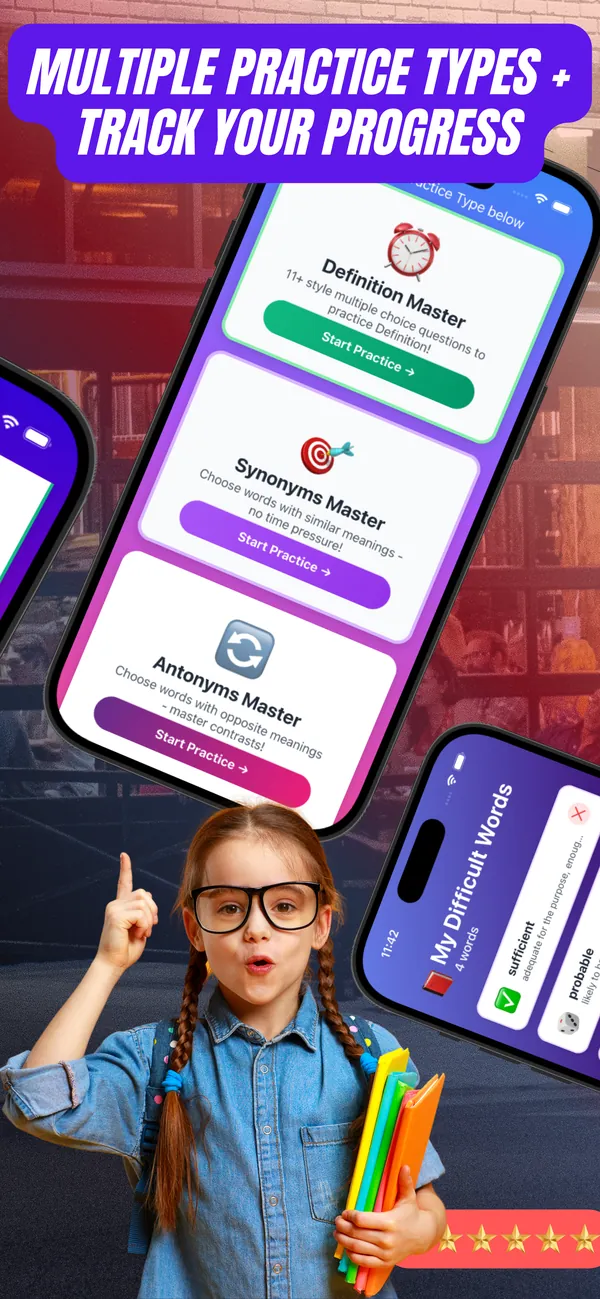
If you are preparing a younger child, or keeping skills up for a later test, our two apps cover the verbal side on phone or tablet.
- 11+ Vocab Master: 2,500+ words for CEM-style and GL Assessment tests across 100 categories, with 6 practice modes, 7 games and unlimited mock tests.
- 11+ Verbal Reasoning Master: 2,000+ verbal reasoning questions covering 38+ question types, with flashcards, mock tests and games.
- Vocab Master has progress tracking, works offline, is ad-free and has audio pronunciation. VR Master has a Hard Questions list.
Both apps come with a 7-day free trial. After that, 11+ Vocab Master is £3.99 a month, £9.99 for 6 months or £12.99 a year, and 11+ Verbal Reasoning Master is £3.99 a month, £9.99 for 6 months or £14.99 a year.
Didn't Pass the 11+: FAQs
Can you appeal if your child didn't pass the 11 plus?
Yes. Name the grammar school on your application by 31 October 2026, and if it refuses a place on 1 March 2027 you can appeal to an independent panel. Under the School Admission Appeals Code, where no local review was held the panel needs evidence your child is of grammar school standard, such as school reports or a letter of support from their school.
What is a Selection Review?
It is Buckinghamshire's local review for children who scored below 121. You send a written case with academic evidence and evidence of exceptional circumstances by 30 October 2026. If the panel agrees, your child counts as qualified. The council says most successful reviews have been for scores between 110 and 120.
Can my child go on a grammar school waiting list if they didn't pass?
Check the school's admissions policy to see how it treats children who did not qualify. Every admission authority must keep a waiting list until at least 31 December of the year of admission, ranked by its oversubscription criteria. In Buckinghamshire's late transfer process, only qualified children are added to grammar school waiting lists.
Can my child try for grammar school after Year 7?
In some areas. Buckinghamshire runs a Late Transfer Test for Year 7 and Year 8 pupils who want a place in Year 8 or Year 9. Registration for September 2027 entry runs from 5 to 23 October 2026 and the test is on 6 February 2027, but places are extremely limited.
Should I still put a grammar school on the application form?
If you might appeal or request a review, yes, because you can only appeal for schools you applied for. Fill the other preferences with schools you would be happy with. GOV.UK says listing only one school will not increase your chances of getting a place there.
Sources
All checked on 5 October 2026. Dates and rules change each year, so always confirm with your own council and the school's admissions policy.
- Secondary Transfer Test results, Buckinghamshire Council
- Selection Review, Buckinghamshire Council
- Apply for a late transfer grammar school test (12 and 13+), Buckinghamshire Council, with its testing timeline and waiting lists and appeals pages
- Medway Test results, Medway Council
- Key dates for applying for secondary school, September 2027 entry, Medway Council
- School admissions (how to apply, waiting lists, appeals and complaints), GOV.UK
- School Admissions Code 2021 (paragraph 2.15), Department for Education
- School Admission Appeals Code 2022 (paragraphs 3.12 and 3.13), Department for Education