In the areas we checked, 11+ results for 2026 arrive by email in early to mid-October, a couple of weeks before the national secondary school application deadline of 31 October 2026. Buckinghamshire releases its Secondary Transfer Test results on 9 October 2026 and Medway releases its Medway Test results on Wednesday 14 October 2026; other areas set their own dates.
That gap matters. You get your child's score first, then you have a short window to decide which schools to put on the application form. This guide explains what the score means, why 'qualified' is not the same as 'offered a place', and what you can do next in each situation.
Whatever the result, the one date that applies to almost every family in England is the same: submit your secondary school application to your home council by 31 October 2026.
When are 11+ results released in 2026?
Each 11+ area publishes its own results date, and the Department for Education's School Admissions Code requires admission authorities to take all reasonable steps to tell parents the outcome of selection tests before the 31 October closing date. Here are the dates confirmed on official council pages when we checked them on 4 October 2026.
| Area / test | Results date | How results arrive | Source |
|---|---|---|---|
| Buckinghamshire Secondary Transfer Test | 9 October 2026 (if your child sat the test on 10 September and the papers reached the Admissions Team by 18 September) | By email if you gave an email address on the online form; otherwise through your child's primary school. Out-of-county and partner schools: to the email used to register | Buckinghamshire Council |
| Medway Test | Wednesday 14 October 2026 | Email after 10am if you gave a valid email address; by post if you did not | Medway Council |
| Kent Test and all other areas | Check your council's 11+ pages | Set by each council or grammar school | Find your local council (GOV.UK) |
| Secondary applications close | 31 October 2026 | Apply to your home council | Medway Council key dates |
| National Offer Day | Monday 1 March 2027 | Your home council tells you which school has offered a place | Medway Council key dates |
If you are in Kent, we have not listed a date because we could not open Kent County Council's own page to confirm it when we checked. Use the council's website rather than a date you have seen on a forum or a tutoring site.
Tip: results emails can land in junk folders. Medway Council says that if you have not received your child's result by Thursday 15 October 2026 you should email medwaytest@medway.gov.uk, and that it cannot give out scores over the phone.
What does a standardised score mean?
A standardised score is your child's raw mark adjusted so that children of different ages, and different years' tests, can be compared fairly. It is not a percentage, so a score of 121 does not mean 121 marks or 121 per cent.
Buckinghamshire explains it clearly. Its papers are marked by GL Assessment and then standardised, taking into account each child's age in years and months on the day of the test, so a child born in August is not penalised for being almost a year younger than a classmate born in September. Each standardised score falls between 60 and 170.
The Buckinghamshire result you receive, the Secondary Transfer Test Score (STTS), is built from three parts:
| Section | Share of the STTS |
|---|---|
| Verbal skills | 50% |
| Mathematical skills | 25% |
| Non-verbal skills | 25% |
An STTS of 121 or more means your child has qualified for a Buckinghamshire grammar school. The council says it expects about 37% of children to reach 121. A higher score than 121 does not give extra priority, because Buckinghamshire grammar schools do not use the score as an admission rule.
Medway works differently on what it shares. Its results give your child's total score, a breakdown for each paper and a decision on whether your child is assessed as suitable for a grammar or non-grammar school. Medway Council says it will not provide raw scores, percentages or the pass mark.
Verbal skills carry half of the Buckinghamshire score, which is one reason vocabulary and verbal reasoning question types get so much attention from families preparing for the test.
Does passing the 11+ guarantee a grammar school place?
No. Reaching the qualifying score makes your child eligible; the school place itself is decided on National Offer Day, 1 March 2027. The School Admissions Code says that when parents are told the outcome of selection tests, it must be made clear that this 'does not equate to a guarantee of a selective place'.
The reason is supply and demand. A popular grammar school may get more applications from qualified children than it has places. When that happens, it uses its published oversubscription criteria (for example, distance from home or siblings at the school) to decide who is offered a place. Medway Council's results page makes the same point.
Buckinghamshire puts it this way: if your child qualifies, the council 'will do our best to offer your child a place at one of your preferred grammar schools on National Offer Day'.
So read each school's admission arrangements before you fill in the form. Schools must publish them on their websites.
My child qualified: what should I do next?
Put your preferred grammar schools on your secondary school application and submit it to your home council by 31 October 2026. Qualifying does not apply for a place on its own.
- Apply through your home council, even if the grammar school is in another county. GOV.UK says you can contact your local council to apply for places at state schools in other areas.
- Use every preference. The Department for Education's Education Hub says you will be able to give at least three preferences, and in some areas as many as six, and that using all of them makes it less likely you are offered a school you did not choose.
- Include a school you would be happy with that is not a grammar school. If the grammar schools are oversubscribed, this is your safety net.
- Check catchment and criteria. Look at each school's oversubscription rules, such as distance or catchment areas, and keep proof of address handy.
- Diary the dates. National Offer Day is Monday 1 March 2027. Medway families must accept or refuse offers by Friday 12 March 2027.
My child didn't reach the score: what are the options?
You can usually still name a grammar school on your application, and many areas offer a review or an appeal. What is available depends on where you apply, so here is what the official pages say for the areas we could check.
Buckinghamshire: Selection Review
A Selection Review lets you explain in writing why your child would be best suited to a grammar school despite scoring below 121. A panel of two grammar school headteachers and one primary school headteacher looks at the case. If it agrees, your child is treated as qualified, just as if they had scored 121.
- Deadline: if you receive results on 9 October, the full case must be in by 30 October.
- When: the council's Selection Review page says most reviews are heard between November and January, with outcomes given on 12 February 2027.
- Realistic odds: the council says that historically most successful reviews have been for children who scored between 110 and 120, and that children with lower scores are rarely successful.
- Pupil Premium: all Buckinghamshire grammar schools offer some places to non-qualified children who receive the Pupil Premium grant, subject to a minimum score set by each school and usually living in the catchment area. You send evidence to the school by 31 October, and you can request a Selection Review as well.
- Remarking: you can ask for the papers to be remarked, but there is a charge, and the council says your child's headteacher will tell you an incorrect mark is most unlikely.
Medway: apply and appeal
If your child was assessed as non-grammar, Medway Council says you can still apply for grammar schools and recommends naming a mixture of grammar and non-grammar schools. You then have the right of appeal for any school on your form, lodged after offers on 1 March 2027. The deadline for on-time appeal requests is Tuesday 13 April 2027.
Appeals everywhere: what panels look at
The School Admission Appeals Code sets the rules in England. For a grammar school appeal where there was no local review, the panel can only uphold the appeal if there is evidence that your child is of the required academic standard, such as school reports or a letter of support from their school. Where a local review (like Buckinghamshire's Selection Review) took place, the panel first looks at whether that review was fair, consistent and objective.
Appeals for applications made on time must be heard within 40 school days of the deadline for lodging them. Grammar schools also keep waiting lists: the School Admissions Code says every admission authority must keep one until at least 31 December of the year your child starts.
Start gathering evidence now: recent school reports and a conversation with your child's headteacher are useful for a review and for an appeal.
How do I talk to my child about the result?
Open the email on your own first, so you can share the news calmly and at a time that suits your child. Opening it in a busy kitchen at breakfast, with siblings watching, is rarely the best moment.
- Praise the effort, not the number. Months of practice on top of Year 6 homework is a real achievement, whatever the score.
- Keep it in proportion. The test decides which type of school is offered, not how well your child will do in life. Buckinghamshire's own guidance describes the result as deciding which type of school will best meet a child's needs.
- Be careful in the playground. Children compare scores. A simple line such as 'we're keeping scores private in our family' saves a lot of awkward conversations.
- Let them see the next step. Visiting the schools you are applying for, grammar or not, helps a child picture the future rather than dwell on a number.
Younger child? What to do in Year 3, 4, 5 and 6
Vocabulary is the one 11+ skill that grows slowly and can't be crammed, so the earlier years are the time to build it. In Buckinghamshire and Medway the test is sat in September of Year 6, and in Buckinghamshire verbal skills make up half of the score, so words learned in Year 3 and Year 4 keep paying off.
This is a sensible pace for most families. Adjust it to your child: some are ready for more in Year 4, and others need longer on the basics.
| School year | Focus | Using 11+ Vocab Master |
|---|---|---|
| Year 3 | Reading for pleasure every day and talking about new words. Keep it light: no tests, no pressure. | A few minutes of the games a couple of times a week, with audio pronunciation so your child hears each word said properly. |
| Year 4 | A regular word habit: a handful of new words most days, plus synonyms and opposites for words your child already knows. | Short daily sessions working through the categories, mixing the practice modes and games so it stays fun. |
| Year 5 | Steady, structured practice: more challenging words, exam-style synonym and antonym questions, and verbal reasoning. | Daily practice plus regular mock tests, using progress tracking to see which words need another look. |
| Year 6 (before the test) | Revision rather than lots of new words, timed practice, and plenty of rest in the last few weeks. | Unlimited mock tests to rehearse, with progress tracking showing which words still need work. It works offline, so it fits into car journeys. |
| Year 6 (after the test) | Keep reading. A wide vocabulary helps in every subject at secondary school, whatever the result. | Optional: a few words a week keeps the habit going. |
Ten minutes of new words on the school run or after tea adds up over a year. Our guide to building 11+ vocabulary step by step has a practical routine, and you can print word lists from our free 11+ resources page.
How 11+ Vocab Master and 11+ Verbal Reasoning Master can help
If you are planning ahead for a younger child, our two apps cover the verbal side of the test on phone or tablet.
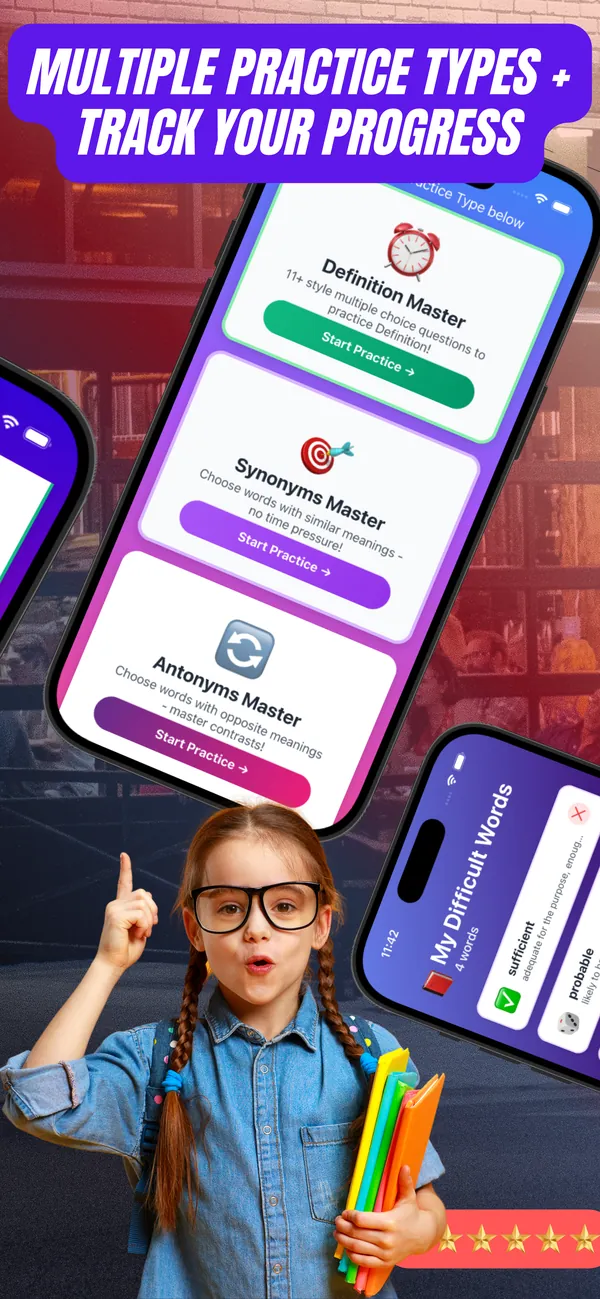
- 11+ Vocab Master: 2,500+ words for CEM-style and GL Assessment tests across 100 categories, with 6 practice modes, 7 games and unlimited mock tests.
- 11+ Verbal Reasoning Master: 2,000+ verbal reasoning questions covering 38+ question types, with flashcards, mock tests and games.
- Vocab Master has progress tracking, works offline, is ad-free and has audio pronunciation. VR Master keeps a Hard Questions list so your child can go back to the ones they got wrong.
Both apps come with a 7-day free trial. After that, 11+ Vocab Master is £3.99 a month, £9.99 for 6 months or £12.99 a year, and 11+ Verbal Reasoning Master is £3.99 a month, £9.99 for 6 months or £14.99 a year.
11+ Results Day FAQs
When do 11+ results come out in 2026?
It depends on your area. Buckinghamshire releases Secondary Transfer Test results on 9 October 2026 and Medway releases Medway Test results on Wednesday 14 October 2026. Other areas, including Kent, publish their own dates on council websites. Results are usually emailed, and councils must take all reasonable steps to send them before the 31 October 2026 deadline.
What is a good 11+ standardised score?
Each area or school sets its own rules: some use a pass mark, others rank children by score. In Buckinghamshire, a Secondary Transfer Test Score of 121 or more qualifies a child for grammar school, and the council expects about 37% of children to reach it. Medway does not give out its pass mark.
Does passing the 11+ mean my child will get a grammar school place?
Not automatically. Passing makes your child eligible, but places are offered on National Offer Day, 1 March 2027. If a grammar school has more qualified applicants than places, it uses its oversubscription criteria, such as distance from home. You must also name the school on your application by 31 October 2026.
Can I appeal if my child didn't pass the 11+?
Usually, yes. You can name a grammar school on your application and appeal if you are refused a place. Under the School Admission Appeals Code, the panel looks for evidence your child is of grammar school standard, such as school reports. Some areas, like Buckinghamshire, also run a Selection Review before offers.
Sources
All checked on 4 October 2026. Dates and rules change each year, so always confirm with your own council.
- Secondary Transfer Test results, Buckinghamshire Council
- Marking the Secondary Transfer Test, Buckinghamshire Council
- Selection Review, Buckinghamshire Council
- Timeline for entry in 2027, Buckinghamshire Council
- Medway Test results, Medway Council
- Key dates for applying for secondary school, September 2027 entry, Medway Council
- School Admissions Code 2021 (paragraphs 1.32 and 2.15), Department for Education
- School Admission Appeals Code 2022 (paragraphs 2.3, 3.12 and 3.13), Department for Education
- Secondary school applications deadline: what you need to know, Department for Education Education Hub (October 2022)
- School admissions: choosing schools, GOV.UK