Year 5 11 plus preparation works best as a calm, steady year built around vocabulary and reading, with exam practice added gradually. In areas such as Buckinghamshire and Medway the test is sat in Year 6, so for a child in Year 5 now, the test comes in September 2027. In Buckinghamshire, registration for it opens in early May 2027.
This plan sets out what to focus on each term from autumn 2026 to the test, a 10-minute daily vocabulary routine, and the official dates we could confirm. Every date and figure comes from council and Department for Education pages we checked on 6 October 2026.
Sources: Buckinghamshire Council, Timeline for entry in 2028, Marking the Secondary Transfer Test; national curriculum, English Appendix 1 (checked 6 October 2026).
The most important Year 5 deadline isn't a test at all: it's registration. In Buckinghamshire it runs from early May to early June 2027. Put a reminder in your calendar now and check your own council's dates in the spring.
When is the 11+ for children now in Year 5?
Children now in Year 5 move to secondary school in September 2028, so in Buckinghamshire they sit the test in early September 2027, at the start of Year 6. Buckinghamshire has already published its outline timeline for 2028 entry, which covers children born between 1 September 2016 and 31 August 2017.
| When | What happens | Source |
|---|---|---|
| Early May 2027 | Buckinghamshire Secondary Transfer Test registration opens | Buckinghamshire Council |
| Early June 2027 | Buckinghamshire registration closes | Buckinghamshire Council |
| Early September 2027 | Buckinghamshire practice and Transfer Tests | Buckinghamshire Council |
| Mid-October 2027 | Buckinghamshire results released | Buckinghamshire Council |
| 31 October 2027 | Secondary school applications close | GOV.UK |
| 1 March 2028 | Secondary school offers sent | GOV.UK |
Medway's test is also sat in Year 6, but its 2027 dates were not published when we checked. Other areas set their own timetable, so look up your council's 11+ pages in the spring term.
- Autumn term 2026
Build the daily word habit and wide reading
- Spring term 2027
Add verbal reasoning, comprehension and some maths practice
- Early May to early June 2027
Register for the test (Buckinghamshire dates)
- Summer term 2027
Introduce timed practice and short mock tests
- Early September 2027
The test, at the start of Year 6 (Buckinghamshire)
Registration and test dates: Buckinghamshire Council (checked 6 October 2026). Term focus is our suggested plan.
Why put vocabulary first in Year 5?
Because word knowledge carries a big share of the marks in tests such as Buckinghamshire's and Medway's, and it builds slowly. Two official examples show how much the verbal and English side counts:
Buckinghamshire
- Two test papers, all multiple-choice.
- One paper tests verbal skills, including comprehension, technical English and verbal reasoning.
- Verbal skills make up 50% of the final score; maths and non-verbal skills are 25% each.
Medway
- Three papers: English, mathematics and reasoning.
- The English paper is 30 minutes: comprehension, punctuation and grammar.
- The English score counts twice in the total, the same as maths; reasoning counts once.
Maths and non-verbal reasoning matter too, and our 11+ non-verbal reasoning guide covers that side. But a child who understands more words is likely to find comprehension passages, synonym and antonym questions and verbal reasoning codes easier. That is why this plan starts every term with words.
Year 5 11 plus preparation: a term-by-term plan
Spread the work across the three school terms, so the load grows slowly and the summer holiday is for light revision, not cramming. This is a suggested pace; adjust it to your child and your area's test.
| Term | Vocabulary and reading | Reasoning, maths and exam skills |
|---|---|---|
| Autumn (September to December 2026) | Start the 10-minute daily word routine. Read every day, including non-fiction. Begin the Year 5 and 6 statutory spelling list. | Find out which test your area uses and its format. Keep up with school maths; no timed papers yet. |
| Spring (January to April 2027) | Add synonyms, antonyms and words in context. Talk about new words found in books. | Introduce verbal reasoning question types and short comprehension pieces. Some non-verbal reasoning puzzles. |
| Summer (April to July 2027) | Revisit the words your child finds hard. Keep reading for pleasure. | Register for the test. Start short timed sections and the occasional mock test. |
| Summer holiday (August 2027) | Light, regular word practice to keep the habit going. | A few mock tests to get used to timing, plus plenty of rest before the test. |
For the English side in more depth, see our 11+ English guide, and for the question types, the 11+ verbal reasoning guide.
A 10-minute daily vocabulary routine for Year 5
Ten minutes a day, most days, is easier to keep up than one long session at the weekend. Here is a simple routine many families fit around tea or the school run:
- Learn (3 minutes)
Meet a handful of new words with their meanings and an example sentence.
- Test (3 minutes)
A quick quiz on synonyms, antonyms or words in context.
- Use (2 minutes)
Your child says or writes one new word in a sentence of their own.
- Review (2 minutes)
Go back over the words they got wrong earlier in the week.
You don't need to buy anything to start. Print our free 11 plus vocabulary list with meanings (500 words), try the free 11+ vocabulary quiz for the test step, and use the printable 11 plus vocabulary worksheets and flashcards for review.
Keep a "tricky words" list on the fridge. When a word has been right three times in a row, your child can cross it off.
Use the Year 5 and 6 statutory word list
The national curriculum lists 100 words that pupils in Years 5 and 6 should learn to spell, and they make a ready-made Year 5 word bank. Here are ten from the list:
- accommodate
- conscience
- exaggerate
- mischievous
- privilege
- prejudice
- rhythm
- sufficient
- thorough
- vehicle
Don't stop at spelling. For each word, ask your child what it means, think of a synonym and an opposite, and use it in a sentence. The Year 5 and 6 programme of study also expects pupils to use dictionaries to check the spelling and meaning of words, and to use a thesaurus, which are both useful 11+ habits.
Reading in Year 5: the habit that does the most work
Daily reading builds vocabulary, comprehension and stamina at the same time. The national curriculum asks Year 5 and 6 pupils to keep reading and discussing an increasingly wide range of fiction, poetry, plays, non-fiction and reference books.
- Mix stories with non-fiction: science, history, nature and news written for children.
- Try a weekly "word hunt": your child notes two or three unfamiliar words from their book and looks them up.
- Ask one question after reading that needs an inference, such as "Why do you think she said that?"
- Read aloud together sometimes. Hearing new words pronounced helps them stick.
Year 3, 4, 5 and 6: where Year 5 fits
Year 5 is the main preparation year, but it builds on habits from Year 3 and Year 4 and leads into a short revision period in Year 6. If you have younger children too, this is the overall shape.
| School year | Focus | Using 11+ Vocab Master |
|---|---|---|
| Year 3 | Reading for pleasure and talking about new words. No tests, no pressure. | A few minutes of the games a couple of times a week, with audio pronunciation. |
| Year 4 | A regular word habit: a handful of new words each week, plus synonyms and opposites. | Short sessions through the categories, mixing modes and games. |
| Year 5 | The plan above: daily words, wide reading, then reasoning and timed practice. | Daily practice and mock tests, with progress tracking showing which words need another look. |
| Year 6 | Revision, not lots of new words, then rest before the test in September. | Unlimited mock tests to rehearse; it works offline, so it fits into car journeys. |
Our guide to building 11+ vocabulary step by step has a weekly routine for every year group.
A Year 5 child still needs time to play, rest and do things they enjoy. If practice starts to feel like a battle, shorten the sessions rather than adding more.
How 11+ Vocab Master and 11+ Verbal Reasoning Master can help in Year 5
Our two apps fit the 10-minute routine on a phone or tablet.
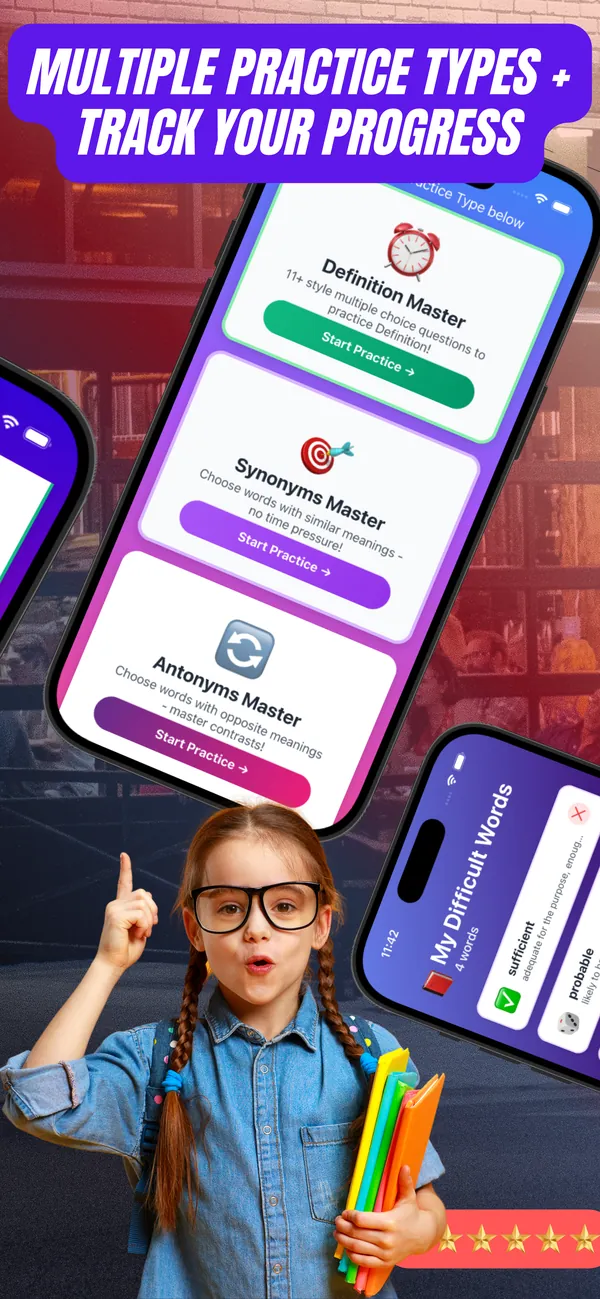
- 11+ Vocab Master, our 11+ vocabulary app: 2,500+ words for CEM-style and GL Assessment tests across 100 categories, 12,000+ vocabulary questions, 6 practice modes, 7 games and unlimited mock tests.
- 11+ Verbal Reasoning Master: 2,000+ verbal reasoning questions covering 38+ question types, with flashcards, mock tests and games.
- Vocab Master has progress tracking, works offline, is ad-free and has audio pronunciation. VR Master has a Hard Questions list. 11+ Vocab Master is Educational App Store Certified.
Both apps come with a 7-day free trial. After that, 11+ Vocab Master is £3.99 a month, £9.99 for 6 months or £12.99 a year, and 11+ Verbal Reasoning Master is £3.99 a month, £9.99 for 6 months or £14.99 a year.
Year 5 11+ Preparation FAQs
When should Year 5 children start 11+ preparation?
Autumn of Year 5 is a sensible time to start a light routine, because in areas such as Buckinghamshire and Medway the test is sat early in Year 6. For children now in Year 5, Buckinghamshire's test is in early September 2027. Start with daily reading and a short vocabulary habit, then add reasoning and timed practice through spring and summer.
When do you register for the 11+ if your child is in Year 5?
In Buckinghamshire, registration is in the summer term of Year 5: for September 2028 entry it opens in early May 2027 and closes in early June 2027. Other areas set their own dates, so check your council's 11+ pages in the spring.
How much time should a Year 5 child spend on 11+ practice?
Short, regular sessions usually work better than long ones. This plan uses a 10-minute daily vocabulary routine plus daily reading, adding reasoning and occasional timed practice later in the year. If practice starts to feel like a battle, shorten the sessions.
What vocabulary should a Year 5 child know for the 11+?
A good starting point is the 100 statutory spelling words for Years 5 and 6 in the national curriculum, such as accommodate, mischievous and privilege. Learn what each word means, a synonym and an opposite, then widen out with a 500-word 11+ vocabulary list and daily reading.
Is Year 5 too late to start preparing for the 11+?
No. In areas such as Buckinghamshire and Medway the test is sat in September of Year 6, so Year 5 is the main preparation year. Starting in the autumn term leaves three terms and a summer holiday to build vocabulary, reading and exam skills at a steady pace.
Sources
All checked on 6 October 2026. Dates change each year, so always confirm with your own council.
- Timeline for entry in 2028, Buckinghamshire Council
- Marking the Secondary Transfer Test and Secondary Transfer Testing process, Buckinghamshire Council
- About the Medway Test, Medway Test dates and How the test is marked, Medway Council
- National curriculum in England: English programmes of study (key stages 1 and 2, and English Appendix 1: spelling), Department for Education
- School admissions: how to apply, GOV.UK