The best starting point for 11 plus spelling words is the national curriculum's two statutory word lists: 100 words for Years 3 and 4 and 100 words for Years 5 and 6. The Department for Education describes them as a mixture of words pupils frequently use in their writing and words they often misspell. Both lists are below, along with a free printable PDF with practice questions and answers.
There is no single official "11+ spelling list"; each area and school sets its own test. These 200 words are a sensible, official base for home practice, whichever test your child sits. Checked against Department for Education pages on 9 October 2026.
Source: national curriculum in England, English Appendix 1: spelling (checked 9 October 2026).
All 200 words with tick boxes, 20 "which spelling is correct?" questions, a look-cover-write-check practice table and an answer key, plus a page about our 11+ Vocab Master app. Five A4 pages, free to print. Download the 11+ spelling words PDF
What are the 11 plus spelling words?
"11 plus spelling words" usually means the tricky words a child is expected to spell by the end of primary school, and the statutory key stage 2 lists are the official version of that. The national curriculum says pupils in Years 3 and 4 should be taught to spell words that are often misspelt, and that in Years 5 and 6 they should understand that the spelling of some words needs to be learnt specifically. Both point to these lists in English Appendix 1.
The Department for Education adds that some of the listed words may seem quite challenging, but that the 100 words in each list can be taught across the four years of key stage 2 alongside other words. So there is no need to learn all 200 at once.
11+ tests differ by area. Look at your council's or school's 11+ information to see what the English paper covers, and use these lists as a solid base either way.
Years 3 and 4 spelling list (100 words)
These are the statutory words for Years 3 and 4, in alphabetical order. Brackets show related forms to learn too: for example, accident(ally) means accident and accidentally.
- accident(ally)
- actual(ly)
- address
- answer
- appear
- arrive
- believe
- bicycle
- breath
- breathe
- build
- busy/business
- calendar
- caught
- centre
- century
- certain
- circle
- complete
- consider
- continue
- decide
- describe
- different
- difficult
- disappear
- early
- earth
- eight/eighth
- enough
- exercise
- experience
- experiment
- extreme
- famous
- favourite
- February
- forward(s)
- fruit
- grammar
- group
- guard
- guide
- heard
- heart
- height
- history
- imagine
- important
- increase
- interest
- island
- knowledge
- learn
- length
- library
- material
- medicine
- mention
- minute
- natural
- naughty
- notice
- occasion(ally)
- often
- opposite
- ordinary
- particular
- peculiar
- perhaps
- popular
- position
- possess(ion)
- possible
- potatoes
- pressure
- probably
- promise
- purpose
- quarter
- question
- recent
- regular
- reign
- remember
- sentence
- separate
- special
- straight
- strange
- strength
- suppose
- surprise
- therefore
- though/although
- thought
- through
- various
- weight
- woman/women
Statutory spelling words for Years 3 and 4 (national curriculum). Source: Department for Education, English Appendix 1.
Years 5 and 6 spelling list (100 words)
These are the statutory words for Years 5 and 6, the ones most relevant in the run-up to a test in Year 6. Many are also excellent vocabulary words, so it is worth checking your child knows what each one means.
- accommodate
- accompany
- according
- achieve
- aggressive
- amateur
- ancient
- apparent
- appreciate
- attached
- available
- average
- awkward
- bargain
- bruise
- category
- cemetery
- committee
- communicate
- community
- competition
- conscience*
- conscious*
- controversy
- convenience
- correspond
- criticise (critic + ise)
- curiosity
- definite
- desperate
- determined
- develop
- dictionary
- disastrous
- embarrass
- environment
- equip (–ped, –ment)
- especially
- exaggerate
- excellent
- existence
- explanation
- familiar
- foreign
- forty
- frequently
- government
- guarantee
- harass
- hindrance
- identity
- immediate(ly)
- individual
- interfere
- interrupt
- language
- leisure
- lightning
- marvellous
- mischievous
- muscle
- necessary
- neighbour
- nuisance
- occupy
- occur
- opportunity
- parliament
- persuade
- physical
- prejudice
- privilege
- profession
- programme
- pronunciation
- queue
- recognise
- recommend
- relevant
- restaurant
- rhyme
- rhythm
- sacrifice
- secretary
- shoulder
- signature
- sincere(ly)
- soldier
- stomach
- sufficient
- suggest
- symbol
- system
- temperature
- thorough
- twelfth
- variety
- vegetable
- vehicle
- yacht
Statutory spelling words for Years 5 and 6 (national curriculum). Source: Department for Education, English Appendix 1.
The spelling patterns behind the tricky words
Learning the pattern behind a word is easier than memorising each word on its own. The national curriculum's guidance for Years 5 and 6 includes these patterns (the rules and example words are non-statutory guidance).
| Pattern | The guidance | Examples |
|---|---|---|
| –cious or –tious | If the root word ends in –ce, the ending is usually –cious (vice → vicious). Exception: anxious. | vicious, precious, delicious, ambitious, cautious |
| –cial or –tial | –cial is common after a vowel and –tial after a consonant, with some exceptions such as initial and financial. | official, special, partial, essential |
| –able or –ible | –able is far more common. It is usually used if a related word ends in –ation, or if a complete root word can be heard. | adorable, considerable, dependable, possible, horrible |
| Adding endings to –fer | Double the r if the –fer is still stressed; don't if the stress moves. | referring, preferred, but reference, preference |
| ei after c | "i before e except after c" works where the sound is /i:/ ("ee"). Exceptions include protein, caffeine and seize. | deceive, receive, ceiling |
| ough | One of the trickiest spellings in English: it is used for several different sounds. | bought, rough, cough, though, through, thorough, plough |
| Silent letters | Some letters that are no longer sounded used to be, hundreds of years ago. | doubt, island, lamb, solemn, knight |
| Nouns –ce, verbs –se | In pairs like these, the noun ends –ce and the verb ends –se. | advice / advise, device / devise |
How to learn 11+ spelling words at home
A few words at a time, practised little and often, works better than long lists in one go. This simple routine fits into ten minutes:
- Look and say
Look at the word, say it out loud and spot the tricky part, such as the double m in accommodate.
- Cover and write
Cover the word and write it from memory.
- Check
Uncover and compare letter by letter. Practise any mistakes again.
- Use it
Write the word in a sentence of your own, so meaning and spelling stick together.
Spelling and vocabulary go hand in hand. Once a word is spelt correctly, check your child knows its meaning, a synonym and an opposite. Our free 11 plus vocabulary list with meanings, the 11 plus vocabulary worksheets and the free 11+ vocabulary quiz help with that side.
If your child does most writing on a screen, do some spelling practice on paper too, where autocorrect can't help.
Year 3, 4, 5 and 6: which spelling list when?
The lists are spread across key stage 2, so match the practice to your child's school year.
| School year | Spelling focus | Using 11+ Vocab Master |
|---|---|---|
| Year 3 | Start the Years 3 and 4 list slowly, a few words a week. | A few minutes of the games, with audio pronunciation. |
| Year 4 | Finish the Years 3 and 4 list and revisit tricky ones. | Short sessions through the categories. |
| Year 5 | Work through the Years 5 and 6 list and its spelling patterns. | Daily practice and mock tests, with progress tracking. |
| Year 6 | Revise the words your child still gets wrong. | Unlimited mock tests; works offline. |
For a full plan for each year, see our Year 3, Year 4 and Year 5 11+ preparation guides, and our guide to building 11+ vocabulary step by step.
How 11+ Vocab Master and 11+ Verbal Reasoning Master can help with vocabulary
Our two apps fit a few minutes of practice on a phone or tablet.
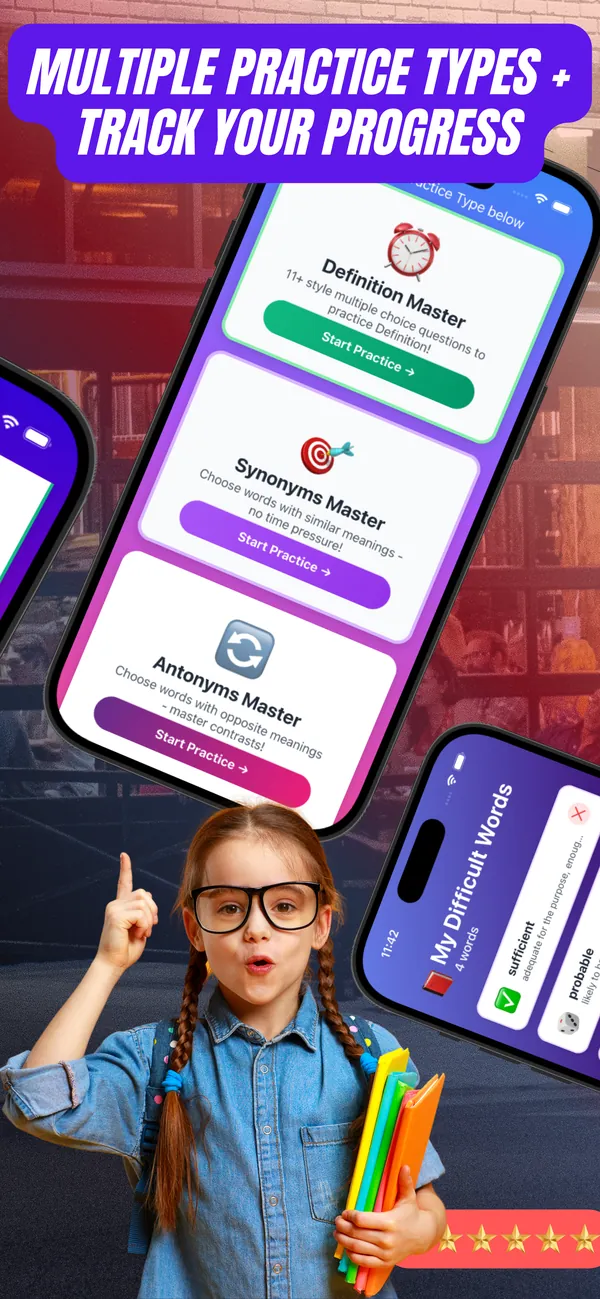
- 11+ Vocab Master, our 11+ vocabulary app: 2,500+ words for CEM-style and GL Assessment tests across 100 categories, 12,000+ vocabulary questions, 6 practice modes, 7 games and unlimited mock tests.
- 11+ Verbal Reasoning Master: 2,000+ verbal reasoning questions covering 38+ question types, with flashcards, mock tests and games.
- Vocab Master has progress tracking, works offline, is ad-free and has audio pronunciation. VR Master has a Hard Questions list. 11+ Vocab Master is Educational App Store Certified.
Both apps come with a 7-day free trial. After that, 11+ Vocab Master is £3.99 a month, £9.99 for 6 months or £12.99 a year, and 11+ Verbal Reasoning Master is £3.99 a month, £9.99 for 6 months or £14.99 a year.
11+ Vocab Master
11+ Verbal Reasoning Master
11+ Spelling Words FAQs
Is there an official 11+ spelling list?
No. There is no single official 11+ spelling list, because each area and school sets its own test. The national curriculum's statutory word lists for Years 3 and 4 and for Years 5 and 6 (100 words each) are the official lists of words primary pupils are expected to learn to spell, so they make a sensible base.
Is there a free 11 plus spelling list PDF?
Yes. Our free PDF has all 200 statutory key stage 2 spelling words with tick boxes, 20 multiple-choice spelling questions, a look-cover-write-check practice table and an answer key, plus a page about our 11+ Vocab Master app: five A4 pages in all.
Which spelling words should a Year 5 child know?
The national curriculum's Years 5 and 6 list has 100 statutory words, such as accommodate, embarrass, necessary and rhythm. Children are expected to learn them across Years 5 and 6, and to keep revising the Years 3 and 4 list.
Why are these words so tricky?
The Department for Education describes the lists as a mixture of words pupils frequently use in their writing and words they often misspell. Many follow unusual patterns, such as silent letters (doubt, island) or the different sounds of ough (bought, rough, through).
How can my child learn 11+ spelling words?
A few words at a time, little and often. Use look, say, cover, write and check, then write each word in a sentence. Practise some spelling on paper, where autocorrect can't help.
Sources
Checked on 9 October 2026.
- National curriculum in England: English programmes of study (key stages 1 and 2, and English Appendix 1: spelling, including the statutory word lists for Years 3 and 4 and Years 5 and 6), Department for Education