Year 4 11 plus preparation should be gentle: daily reading, a short word habit and confident times tables, with no mock tests or pressure. In areas such as Buckinghamshire and Medway the test is sat early in Year 6, so a child in Year 4 now has about two years to go. That is plenty of time to build vocabulary slowly, which is the part that can't be rushed later.
This guide covers whether Year 4 is too early, what to focus on each term, a 10-minute word habit, the national curriculum's Year 3 and 4 word list and the multiplication tables check in June. Every fact comes from Department for Education and council pages we checked on 7 October 2026.
Sources: national curriculum, English Appendix 1; Multiplication tables check: information for parents; Buckinghamshire Council and its test timeline (checked 7 October 2026).
In Year 4, aim for habits, not results. Ten minutes of words and plenty of reading each week will do more than any practice paper at this age.
Is Year 4 too early to start 11+ preparation?
It is not too early for gentle habits, but it is usually too early for exam practice. Many parents worry about starting either too late or too soon. A useful way to think about Year 4 is "foundations": the reading, word knowledge and number fluency that make Year 5 preparation easier.
Good in Year 4
- Reading every day, for pleasure
- A short, regular word habit
- Talking about new words and what they mean
- Confident times tables up to 12 × 12
- Word games and puzzles
Better left until later
- Timed practice papers and mock tests
- Long weekly tutoring sessions
- Learning question tricks for a specific test
- Comparing scores with other children
When your child moves into Year 5, our Year 5 11+ preparation plan picks up from here with a term-by-term plan and the registration dates.
Year 4 11 plus preparation: a term-by-term focus
Keep the load light all year and let the habits do the work. This is a suggested pace for a child in Year 4 in 2026 to 2027; adjust it to your child.
- Autumn term
Start the 10-minute word habit and a daily reading time. Begin the Year 3 and 4 word list.
- Spring term
Add synonyms and opposites for familiar words, and simple word puzzles. Keep times tables practice short and regular.
- June
The Year 4 multiplication tables check at school.
- Summer holiday
Lots of reading for fun, library visits and word games. No formal practice needed.
Suggested plan. Check date: Standards and Testing Agency (checked 7 October 2026).
A 10-minute word habit for Year 4
A few minutes most days builds vocabulary steadily without it feeling like homework. Keep it playful:
- Meet (3 minutes)
Look at a handful of new words together, with a meaning and an example sentence for each.
- Play (4 minutes)
A quick game or quiz: match words to meanings, or find a word that means the same or the opposite.
- Use (3 minutes)
Your child uses one new word in a sentence, out loud or in writing, and you try to use it at teatime.
For free material, print our 11 plus vocabulary list with meanings and pick a few easier words a week, try the free 11+ vocabulary quiz together, or use the printable 11 plus vocabulary flashcards.
Let your child "teach" you a word each week. Explaining a meaning out loud is one of the best checks that they really understand it.
Use the Year 3 and 4 statutory word list
The national curriculum lists 100 words that pupils in Years 3 and 4 should learn to spell, and they make a ready-made Year 4 word bank. Here are ten from the list:
- believe
- breathe
- century
- experiment
- favourite
- knowledge
- peculiar
- separate
- therefore
- various
Go beyond spelling: ask what each word means, think of a word with a similar meaning, and use it in a sentence. The Year 3 and 4 programme of study also expects pupils to use dictionaries to check the meaning of words they have read, so a children's dictionary at home is worth having.
Reading in Year 4
Reading is one of the best ways to meet new words, so make it the centre of Year 4. The national curriculum asks Year 3 and 4 pupils to listen to and discuss a wide range of fiction, poetry, plays, non-fiction and reference books, and to grow familiar with fairy stories, myths and legends.
- Mix genres: adventure, myths and legends, poetry, and non-fiction about things your child loves.
- Keep reading aloud to your child, choosing books slightly above the level they read alone.
- Pause on an interesting word now and then and ask what they think it means from the sentence around it.
- Use the library: free, and it lets your child choose.
Year 4 maths: the multiplication tables check
Year 4 pupils in England take the multiplication tables check in June. The Standards and Testing Agency, part of the Department for Education, says it checks whether children can fluently recall their times tables up to 12.
| What | Detail |
|---|---|
| When | June of Year 4 |
| Format | On screen: 3 practice questions, then 25 times table questions |
| Time | 6 seconds per question; on average no longer than 5 minutes |
| Results | The teacher shares your child's score with you; there is no pass mark |
The guidance for parents says you don't need to do anything extra to prepare, though teachers may ask you to practise times tables at home. Quick, confident recall of tables is also handy later, when 11+ maths papers ask children to work under time pressure.
Year 3, 4, 5 and 6: where Year 4 fits
Year 4 sits between the gentle start of Year 3 and the main preparation year, Year 5. This is the overall shape.
| School year | Focus | Using 11+ Vocab Master |
|---|---|---|
| Year 3 | Reading for pleasure and talking about new words. No tests, no pressure. | A few minutes of the games a couple of times a week, with audio pronunciation. |
| Year 4 | The plan above: a short word habit, wide reading and confident times tables. | Short sessions through the categories, mixing the practice modes and games so it stays fun. |
| Year 5 | The main preparation year: daily words, reasoning and, later, timed practice. | Daily practice and mock tests, with progress tracking showing which words need another look. |
| Year 6 | Revision before the test, then rest. | Unlimited mock tests to rehearse; it works offline, so it fits into car journeys. |
Our guide to building 11+ vocabulary step by step has a weekly routine for every year group.
If your child starts to dread word time, stop for a week and just read together. A positive attitude now is worth more than a few extra words.
How 11+ Vocab Master and 11+ Verbal Reasoning Master can help in Year 4
Our two apps fit the 10-minute routine on a phone or tablet.
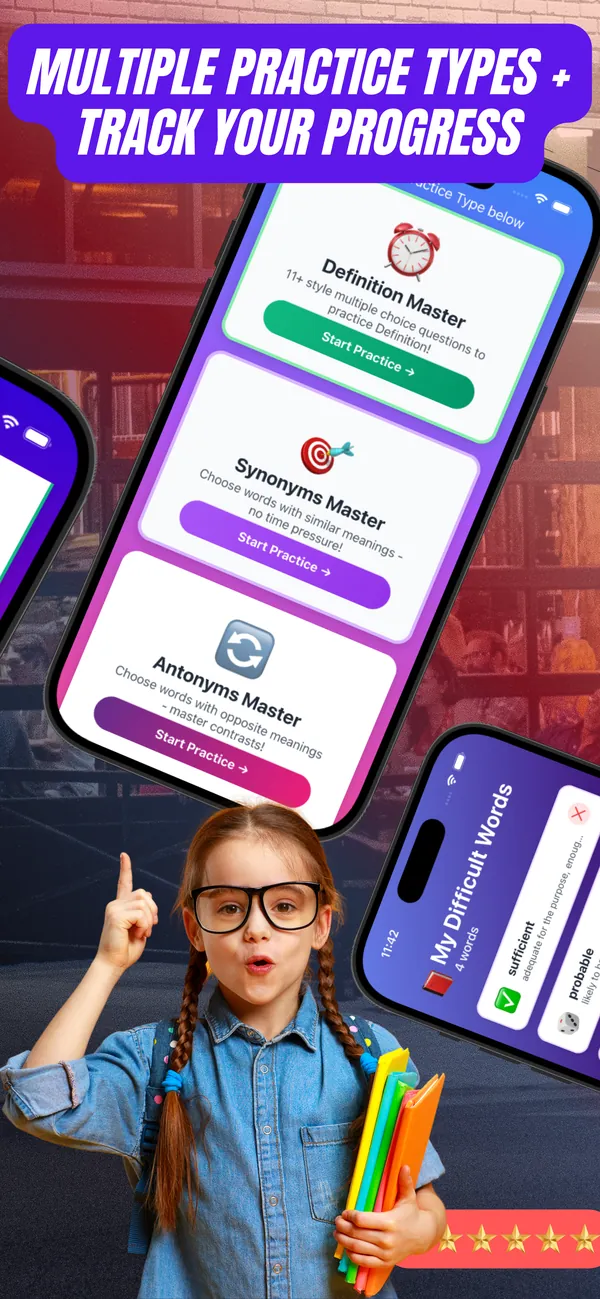
- 11+ Vocab Master, our 11+ vocabulary app: 2,500+ words for CEM-style and GL Assessment tests across 100 categories, 12,000+ vocabulary questions, 6 practice modes, 7 games and unlimited mock tests.
- 11+ Verbal Reasoning Master: 2,000+ verbal reasoning questions covering 38+ question types, with flashcards, mock tests and games.
- Vocab Master has progress tracking, works offline, is ad-free and has audio pronunciation. VR Master has a Hard Questions list. 11+ Vocab Master is Educational App Store Certified.
Both apps come with a 7-day free trial. After that, 11+ Vocab Master is £3.99 a month, £9.99 for 6 months or £12.99 a year, and 11+ Verbal Reasoning Master is £3.99 a month, £9.99 for 6 months or £14.99 a year.
11+ Vocab Master
11+ Verbal Reasoning Master
Year 4 11+ Preparation FAQs
Is Year 4 too early to start preparing for the 11+?
It is not too early for gentle habits such as daily reading, a short word routine and confident times tables, but it is usually too early for timed practice papers. In areas such as Buckinghamshire and Medway the test is sat early in Year 6, so Year 4 is best used for foundations, with more structured preparation in Year 5.
What should a Year 4 child do for the 11+?
Read every day, spend about 10 minutes most days on new words, talk about what words mean and practise times tables. The national curriculum's 100 statutory spelling words for Years 3 and 4 make a good starting word bank.
Do I need to prepare my child for the Year 4 multiplication tables check?
The Standards and Testing Agency's guidance for parents says you don't need to do anything extra to prepare, although teachers may ask you to practise times tables at home. The check is in June: 25 on-screen questions with 6 seconds each, and there is no pass mark.
How much 11+ practice should a Year 4 child do?
Keep it short and regular. This guide suggests a 10-minute word habit most days plus daily reading, with no mock tests. If your child starts to dread it, pause for a week and just read together.
When will my Year 4 child sit the 11+?
In areas such as Buckinghamshire and Medway the 11+ is sat early in Year 6, so a child in Year 4 now will usually sit it in September two years from now. Check your own council's 11+ pages, as each area sets its own dates.
Sources
All checked on 7 October 2026.
- National curriculum in England: English programmes of study (key stages 1 and 2, and English Appendix 1: spelling), Department for Education
- Multiplication tables check: information for parents, Standards and Testing Agency (part of the Department for Education)
- Marking the Secondary Transfer Test and Timeline for entry in 2028, Buckinghamshire Council
- Medway Test dates, Medway Council