Good vocabulary games for 11 plus practice are short, free and played out loud: synonym chains, opposites, odd one out, shades of meaning, analogies and prefix challenges. Each one practises word skills from the national curriculum, such as how words are related as synonyms and antonyms (a Year 6 topic). Below are eight games you can play at home or in the car with no equipment, each with a worked example.
Games help because children say, hear and use the words rather than just reading a list. We suggest 5 to 10 minutes a day, and you can mix them with a written list and quiz when your child is ready.
Pick one game a day, play it for 5 to 10 minutes and finish by putting one new word into a sentence. Using the word in a sentence helps it stick.
Source: National curriculum in England, English Appendix 2: vocabulary, grammar and punctuation (checked 12 October 2026). Quiz figure: our free quiz page.
Why vocabulary games help with the 11+
Vocabulary games turn the word skills that 11+ English and verbal reasoning questions rely on into quick, spoken practice. The national curriculum asks teachers to show pupils "the relationships between words" and "nuances in meaning", and to teach them how to work out the meanings of unknown words. Those are exactly the skills behind synonym, antonym, odd-one-out and analogy questions.
The curriculum also says pupils should be taught to "use relevant strategies to build their vocabulary" when they speak. A game around the kitchen table does just that, and it feels nothing like homework.
11+ tests differ by area, so look at your council's or school's 11+ information to see what the English and verbal reasoning papers cover. These games build general word knowledge, which helps whichever test your child sits.
8 vocabulary games for 11 plus practice at a glance
All eight games need nothing but a few words and 5 to 10 minutes. Start with games 1 to 3 for younger children, add games 4 and 5 in Year 4, and games 6 to 8 from Year 5.
| Game | Skill it practises | Best from |
|---|---|---|
| 1. Same or opposite? | Synonyms and antonyms | Year 3 |
| 2. Synonym chain | Synonyms and quick recall | Year 3 |
| 3. Word family tree | Word families and meaning | Year 3 |
| 4. Shades of meaning | Nuances in meaning | Year 4 |
| 5. Odd one out | Grouping words by meaning | Year 4 |
| 6. Prefix challenge | Prefixes that change meaning | Year 5 |
| 7. Analogy pairs | Relationships between words | Year 5 |
| 8. Definition bluff | Meanings of unknown words | Year 5 |
1. Same or opposite?
Say two words; your child answers "same" or "opposite" as fast as they can. It practises synonyms and antonyms, which the curriculum lists for Year 6, and it suits the school run.
Example: brave and courageous (same); scarce and plentiful (opposite); reluctant and unwilling (same); ancient and modern (opposite).
Make it harder: your child gives the pair and you answer. Choosing a pair that works is harder than spotting one.
2. Synonym chain
Take turns to say a word that means the same as the last one until someone gets stuck. It builds quick recall, and a chain often drifts in meaning, which is a good thing to talk about.
Example: happy → cheerful → glad → content. Is content quite the same as cheerful? Not really: you can be content without being bubbly. That conversation is the learning.
3. Word family tree
Give a root word and see how many family members your child can name in a minute. The Year 3 curriculum covers word families "showing how words are related in form and meaning", using solve, solution, solver, dissolve and insoluble as its example.
Example: act → action, actor, active, activity, react. Ask what each one means and how it links back to act.
4. Shades of meaning
Give three or four words with a similar meaning and ask your child to put them in order, from weakest to strongest. This is the "nuances in meaning" the curriculum talks about, and it helps children pick the most precise word in a multiple-choice question.
- Warm
A little above comfortable.
- Hot
Much warmer than warm.
- Scorching
Extremely hot, the strongest of the three.
Shades of meaning: weakest to strongest.
More sets to try: cross, angry, furious; tired, weary, exhausted; nibble, eat, devour.
5. Odd one out
Say four words; three share a meaning and one doesn't. Your child names the odd one out and explains why. Odd one out is one of the common question types in our 11+ verbal reasoning guide.
Example: glad, joyful, delighted, gloomy. Answer: gloomy, because the other three mean 'happy'.
Harder: rapid, swift, hasty, sluggish. Answer: sluggish, because the other three mean 'fast'.
6. Prefix challenge
Call out a prefix and a word; your child joins them and says what the new word means. The Year 5 curriculum gives the verb prefixes dis–, de–, mis–, over– and re– as examples, and Year 3 covers prefixes such as super–, anti– and auto–.
| Prefix + word | New word | Meaning |
|---|---|---|
| dis + appear | disappear | to go out of sight |
| mis + behave | misbehave | to behave badly |
| de + frost | defrost | to remove ice from, or thaw |
| over + heat | overheat | to become too hot |
| re + build | rebuild | to build again |
7. Analogy pairs
Say the first half of an analogy and let your child finish it, then explain the link. Analogies are another common verbal reasoning question type, and saying the link out loud is a useful habit.
Example: Hot is to cold as tall is to … short (opposites). Puppy is to dog as kitten is to … cat (young animal and adult). Author is to book as composer is to … music (who makes what).
8. Definition bluff
Read out a word with one real meaning and two made-up ones; everyone guesses which is real. Children learn to weigh up which meaning fits, and working out the meanings of unknown words is something the curriculum asks teachers to teach.
Example: frugal. (a) careful not to spend much money; (b) covered in fruit; (c) very loud. Answer: (a). Then take turns: the person who knows the word writes the fake meanings.
After any game, say the correct meaning and use the word in a sentence, so the made-up answers don't stick instead.
11 plus vocabulary games online for free
For screen-based practice, our free 11+ vocabulary quiz has seven topics with 10 free questions each, and needs no sign-up. Pair it with paper practice so new words are written down as well as clicked.
For the words to play with, print our free 11 plus vocabulary list with meanings and the 11 plus vocabulary worksheets. Our 11+ synonyms list and antonyms list are ready-made sets for games 1 and 2.
What to do in Years 3, 4, 5 and 6
Match the games to your child's school year: light and spoken early on, more structured as the test gets closer.
| School year | Focus | Using 11+ Vocab Master |
|---|---|---|
| Year 3 | Reading for pleasure, plus games 1 to 3. | A few minutes of the games, with audio pronunciation. |
| Year 4 | A daily word habit; add shades of meaning and odd one out. | Short sessions through the categories. |
| Year 5 | All eight games, plus exam-style questions. | Practice modes and mock tests, with progress tracking. |
| Year 6 | Revision of tricky words; keep games light before the test. | Unlimited mock tests; works offline. |
For a fuller plan, see our guide to building 11+ vocabulary year by year.
How 11+ Vocab Master and 11+ Verbal Reasoning Master can help
When your child wants to play on a screen, our two apps turn the same skills into games and quick questions on a phone or tablet.
- 11+ Vocab Master, our 11+ vocabulary app: 2,500+ words for CEM-style and GL Assessment tests across 100 categories, 12,000+ vocabulary questions, 6 practice modes, 7 games and unlimited mock tests.
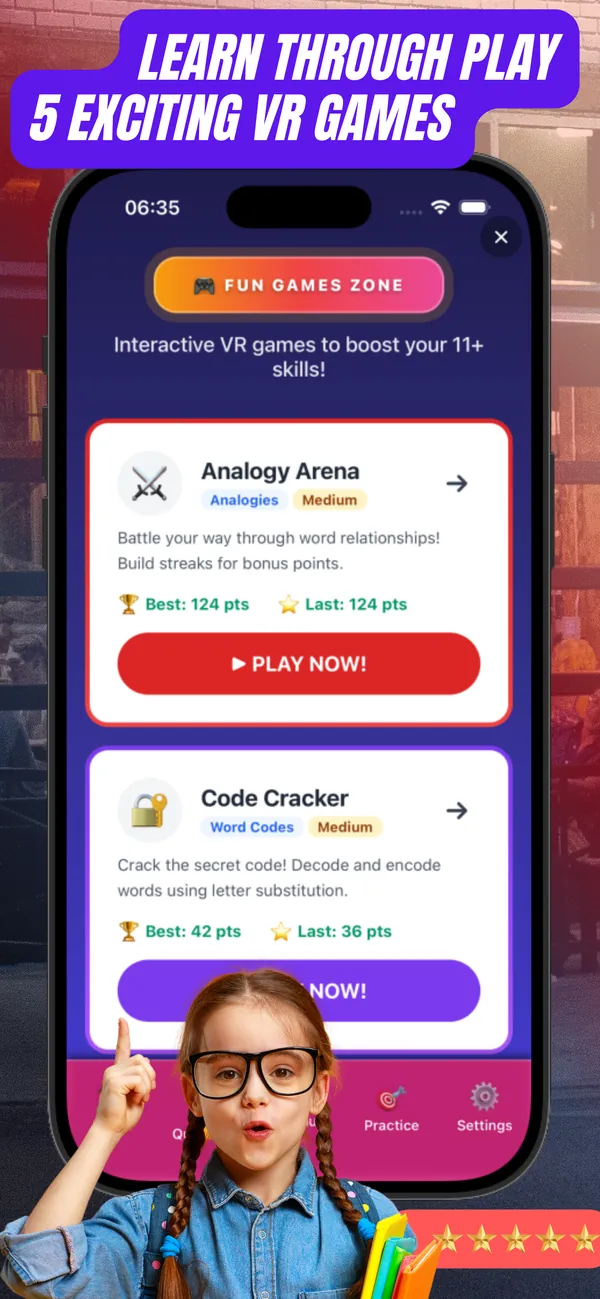
- 11+ Verbal Reasoning Master: 2,000+ verbal reasoning questions covering 38+ question types, with flashcards, mock tests and five VR games, such as Analogy Arena and Code Cracker.
- Vocab Master has progress tracking, works offline, is ad-free and has audio pronunciation. VR Master has a Hard Questions list. 11+ Vocab Master is Educational App Store Certified.
Both apps come with a 7-day free trial. After that, 11+ Vocab Master is £3.99 a month, £9.99 for 6 months or £12.99 a year, and 11+ Verbal Reasoning Master is £3.99 a month, £9.99 for 6 months or £14.99 a year.
11+ Vocab Master
11+ Verbal Reasoning Master
11+ vocabulary games FAQs
What are good vocabulary games for 11 plus practice?
Short spoken games work well: same or opposite, synonym chains, word family trees, shades of meaning, odd one out, prefix challenges, analogy pairs and definition bluff. They need no equipment, take 5 to 10 minutes and practise the word skills behind 11+ English and verbal reasoning questions, such as synonyms, antonyms and word relationships.
Are there free 11 plus vocabulary games online?
Yes. Our free 11+ vocabulary quiz has seven topics of 10 free questions each, with instant answers and no sign-up. The eight games in this guide are free too and need no screen at all, so you can play them in the car, at the table or on a walk.
How long should 11+ vocabulary games last?
Five to ten minutes a day is enough for most children. Short, regular games keep words fresh and stop practice from feeling like a chore. End each session by putting one new word into a sentence: using a word helps it stick.
Do vocabulary games help with verbal reasoning?
They can. Synonyms, antonyms, odd one out and analogies are common verbal reasoning question types, and games 1, 5 and 7 in this guide practise them out loud. Follow up with exam-style questions too, because tests also have a time limit and a set answer format.
When should my child start vocabulary games for the 11+?
Spoken word games suit children from Year 3, alongside plenty of reading for pleasure. Add more structured games in Year 4 and exam-style practice in Year 5. Tests vary by area, so check your area's 11+ information for the test date and format.
Sources
Checked on 12 October 2026.
- National curriculum in England: English programmes of study (key stages 1 and 2, including spoken language and English Appendix 2: vocabulary, grammar and punctuation), Department for Education