A strong Year 5 reading list mixes everyday stories, mystery, adventure, fantasy, classics, true stories, graphic novels, non-fiction and poetry. Here are 43 books for 9- and 10-year-olds, in nine categories, each with a short note on why it helps build vocabulary. We checked every title and author on BookTrust’s Bookfinder, and 26 of the books come from BookTrust’s Great Books Guide 2026–27.
Year 5 is the key year for 11+ vocabulary. In areas such as Buckinghamshire and Medway, the 11+ is sat in September of Year 6, so wide reading now builds the words your child will need for English and verbal reasoning. In Years 5 and 6, the national curriculum asks pupils to read an increasingly wide range of fiction, poetry, plays, non-fiction and reference books or textbooks, including fiction from our literary heritage.
Keep reading for pleasure at the centre of Year 5. Add one classic or stretch book at a time, collect three new words per chapter and revisit them each week: that is how reading turns into 11+ vocabulary.
Sources: BookTrust Bookfinder; National curriculum in England: English programmes of study (checked 16 October 2026).
How we chose this Year 5 reading list
Every book has a BookTrust interest age that includes 9 or 10. We mixed books from BookTrust’s Great Books Guide 2026–27 with well-loved classics, left out the books already on our Year 3 and Year 4 reading lists, then grouped them by type and wrote our own vocabulary notes.
Easier
- A younger BookTrust interest or reading age, or more pictures
- Good for confidence and quick wins
Stretch
- A BookTrust reading age of 10+
- Read together or alone, talking about new words as you go
Unmarked books sit in the middle. Some books on this list deal with bigger themes, such as loss, illness, war and racism, and a few include murder mysteries or scary scenes. Have a look at the BookTrust page first if you’re unsure whether a book suits your child.
Funny and everyday life for Year 5
Stories about school, family and friendship give children words for feelings and relationships, which come up often in 11+ comprehension.
| Title | Author | Why it’s good for vocabulary |
|---|---|---|
| Bím Blake’s Hot Takes: My Pencil Case Doesn’t Define Me | Tọlá Okogwu, illustrated by Ariyana Taylor | An 11-year-old’s journal as she starts secondary school; good for informal and formal voice |
| The Dad Trap | Ian Eagleton | William, his adoptive dad and a new girl at his Year 6 desk; good for words about friendship and change |
| Medusa Gorgon’s Bad Hair Day | Bethany Walker, illustrated by Katie Abey | A funny diary that sends Medusa from ancient Greece to a modern secondary school; a way into myth words such as retaliation |
| Wonder | R J Palacio | Auggie starts a new school after being home-schooled; good for words about kindness and acceptance |
| Paddock Grove: A Pony to Own | JP Rose | A scholarship to an equestrian boarding school; horse and riding words |
| The Night I Borrowed Time | Iqbal Hussain | Zubair, his six older brothers and a gran from Pakistan; good for family and feelings words |
| The Shell Keepers (easier) | Truly Johnston | Beachcombing at Whiteshell Bay and missing a Sri Lankan grandfather; seaside and memory words |
| Nate Yu’s Blast from the Past | Maisie Chan | A ghost linked to a First World War shell; history and heritage words |
Mystery and thrillers for Year 5
Mysteries reward careful reading, which is exactly the skill 11+ comprehension tests.
| Title | Author | Why it’s good for vocabulary |
|---|---|---|
| YOU VS The Poison Plot | Josh Hicks | An interactive mystery where the reader is an investigative journalist; detective and journalism words |
| The Street Art Mystery | Sharna Jackson | Three friends, Notting Hill Carnival and a crime to solve; clue and suspect words |
| Murder at Hotel Marvelo (stretch) | Ruth Lauren, illustrated by Federica Fenna | A wizard found dead in a hotel where no magic works; a whodunnit with rich setting words |
| How to Steal the Future | Christopher Edge | A deadly, ever-changing maze; good for words such as impenetrable and labyrinth |
| Jamaal Target: PHANTOM Agent (stretch) | Isaac Hamilton-McKenzie | Super strength, a kidnapped friend and a secret organisation; fast-paced spy words |
| The Ministry of Manners (stretch) | David Solomons | A world where trees record every word; dystopia words such as surveillance |
Adventure and survival for Year 5
Adventure stories are packed with action verbs and setting description, which are useful in 11+ creative writing.
| Title | Author | Why it’s good for vocabulary |
|---|---|---|
| The Explorer (stretch) | Katherine Rundell, illustrated by Hannah Horn | A plane crash in the Amazon rainforest; survival words such as shelter |
| Kensuke’s Kingdom (stretch) | Sir Michael Morpurgo, illustrated by Michael Foreman | A boy washed up on a seemingly deserted island; words for loneliness and friendship |
| The Polar Bear Explorers’ Club (stretch) | Alex Bell, illustrated by Tomislav Tomic | Stella sets out to prove she can be an explorer; snow and expedition words |
| The Last Journey (stretch) | Stacy Gregg, illustrated by Suzie Mason | Pusskin, a cat told he is the Chosen One; journey and danger words such as treacherous |
| Birdlands | Anthony McGowan | Three injured birds struggling to survive; nature words with a strong emotional pull |
| Swanfall | Sophie Kirtley | Arctic swans returning to the wetlands; good for winter and wildlife description |
Fantasy and magic for Year 5
Fantasy worlds use rich, unusual vocabulary that children can borrow for their own stories.
| Title | Author | Why it’s good for vocabulary |
|---|---|---|
| A Pinch of Magic | Michelle Harrison | A tumbledown inn on the dismal island of Crowstone; strong setting description |
| The Strangeworlds Travel Agency (stretch) | L D Lapinski | A dusty old shop full of suitcases; mystery and travel words |
| Ghostcloud | Michael Mann, illustrated by Chaaya Prabhat | A smoggy, alternate-reality London and Battersea Power Station; words such as vicious and smog |
| Spirit Warriors | Ashley Thorpe, illustrated by Gashwayne Hudson | A hotel enchanted by Obeah magic and a ceremony on the beach in Ocho Rios; magic words |
| The Last Wolf | Rob Biddulph | Twins, secret werewolf research and the land of Moonhaven; suspense words |
| The Starlight Rebel | Lisette Auton | The year 3897, a neon-lit future where nature is forgotten; science fiction words |
| The Girl Who Drank the Moon (stretch) | Kelly Barnhill | A witch, a village and a baby accidentally fed the moon; rich, descriptive writing |
| The House With Chicken Legs | Sophie Anderson | Marinka, her grandmother the Yaga and the mysterious Gate; myth and legend words |
Classics to share for Year 5
Classic novels introduce older, more formal words that 11+ comprehension passages often use.
| Title | Author | Why it’s good for vocabulary |
|---|---|---|
| The Lion, the Witch and the Wardrobe | C S Lewis | Narnia, frozen in eternal winter; words such as enslaved and eternal |
| The Secret Garden | Frances Hodgson Burnett | Spoilt, bad-tempered Mary and the Yorkshire Moors; character and setting words |
| Five Children and It (easier) | E Nesbit | A sand-fairy that grants wishes; old-fashioned words such as jolly |
| Alice’s Adventures in Wonderland (easier) | Lewis Carroll, illustrated by Alison Jay | Full of playful language and nonsense; great for wordplay |
| The Little Prince (easier) | Antoine de Saint-Exupéry, translated by Katherine Woods | A pilot stranded in the Sahara; a simple fable with big ideas |
| The Hobbit (stretch) | JRR Tolkien | Bilbo, Gandalf and a band of dwarves; rich description to read together |
History and true stories for Year 5
Real events bring in subject words from history and geography.
| Title | Author | Why it’s good for vocabulary |
|---|---|---|
| The Island at the End of Everything (stretch) | Kiran Millwood Hargrave | An island in quarantine; words for separation and hope |
| Dance of Resistance: The Josephine Baker Story | Catherine Johnson, illustrated by Katie Hickey | The true story of a dancer, actress and war hero; words such as segregation |
Comics and graphic novels for Year 5
Graphic novels support longer, harder words with pictures.
| Title | Author | Why it’s good for vocabulary |
|---|---|---|
| Legacy: The Shadow Rises (easier) | Tom Fickling and Will Fickling, illustrated by Zak Simmonds-Hurn | The Jindari Empire and the Fortress of Shadow; epic fantasy words |
| Unfairies (easier) | Huw Aaron | Treacherous, backstabbing fairies; funny with strong describing words |
Non-fiction for Year 5
Fact books build subject vocabulary in science, technology and health.
| Title | Author | Why it’s good for vocabulary |
|---|---|---|
| From AI to Wi-Fi: How the Internet Works! | Craig Steele, illustrated by Terri Po | Search engines, Wi-Fi and AI explained; technology words |
| Diagnosis Detectives: Tummy Trouble | Ben Elcomb, illustrated by Terri Po | Symptoms such as fever and diarrhoea; health and science words |
| How to Survive an Apocalypse (easier) | Coby Coonradt and Cameron Hardy, illustrated by Victoria Stebleva | Purifying water and other survival skills; science words |
Poetry for Year 5
Poems are short, so children can notice every word, and rhythm helps new words stick.
| Title | Author | Why it’s good for vocabulary |
|---|---|---|
| I Tell Myself I’m Awesome: Poems for your mind (easier) | Joshua Seigal, illustrated by Chris Piascik | Poems about emotions and the mind; feelings words and playful forms |
| Poems Aloud (easier) | Joseph Coelho, illustrated by Daniel Gray-Barnett | Tongue twisters, riddles and poems to perform; great for speaking aloud |
How to turn reading into 11+ vocabulary
A short word hunt after each chapter turns everyday reading into vocabulary practice. In Years 5 and 6, the national curriculum asks pupils to use dictionaries to check the spelling and meaning of words, so this fits what your child does at school.
- Spot three new words
While reading, note three words per chapter that are new or interesting.
- Guess, then check
Guess the meaning from the sentence, then look it up together in a children’s dictionary.
- Use it in a sentence
Say or write a sentence of their own with the word, ideally about something from their day.
- Find a twin and an opposite
Think of a word with a similar meaning and one with the opposite meaning, if there is one.
- Practise little and often
Keep the words in a notebook and play a quick game with them at the weekend.
Our vocabulary games for 11 plus work well with a word-hunt notebook, and the guide to mastering 11+ vocabulary explains how to build a longer-term routine. For spelling, our page on 11+ spelling words has the statutory Years 5 and 6 list.
Alongside reading, our 11 plus vocabulary list with meanings and the free 11+ vocabulary quiz show the kind of words that come up in the 11+. In Year 5, a few minutes on them each week fits well beside the word hunt.
Printable Year 5 reading checklist
Print this page and let your child tick off each book as they finish it. There’s no need to read them all; the aim is variety.
- Bím Blake’s Hot Takes: My Pencil Case Doesn’t Define Me, Tọlá Okogwu
- The Dad Trap, Ian Eagleton
- Medusa Gorgon’s Bad Hair Day, Bethany Walker
- Wonder, R J Palacio
- Paddock Grove: A Pony to Own, JP Rose
- The Night I Borrowed Time, Iqbal Hussain
- The Shell Keepers, Truly Johnston
- Nate Yu’s Blast from the Past, Maisie Chan
- YOU VS The Poison Plot, Josh Hicks
- The Street Art Mystery, Sharna Jackson
- Murder at Hotel Marvelo, Ruth Lauren
- How to Steal the Future, Christopher Edge
- Jamaal Target: PHANTOM Agent, Isaac Hamilton-McKenzie
- The Ministry of Manners, David Solomons
- The Explorer, Katherine Rundell
- Kensuke’s Kingdom, Sir Michael Morpurgo
- The Polar Bear Explorers’ Club, Alex Bell
- The Last Journey, Stacy Gregg
- Birdlands, Anthony McGowan
- Swanfall, Sophie Kirtley
- A Pinch of Magic, Michelle Harrison
- The Strangeworlds Travel Agency, L D Lapinski
- Ghostcloud, Michael Mann
- Spirit Warriors, Ashley Thorpe
- The Last Wolf, Rob Biddulph
- The Starlight Rebel, Lisette Auton
- The Girl Who Drank the Moon, Kelly Barnhill
- The House With Chicken Legs, Sophie Anderson
- The Lion, the Witch and the Wardrobe, C S Lewis
- The Secret Garden, Frances Hodgson Burnett
- Five Children and It, E Nesbit
- Alice’s Adventures in Wonderland, Lewis Carroll
- The Little Prince, Antoine de Saint-Exupéry, translated by Katherine Woods
- The Hobbit, JRR Tolkien
- The Island at the End of Everything, Kiran Millwood Hargrave
- Dance of Resistance: The Josephine Baker Story, Catherine Johnson
- Legacy: The Shadow Rises, Tom Fickling and Will Fickling
- Unfairies, Huw Aaron
- From AI to Wi-Fi: How the Internet Works!, Craig Steele
- Diagnosis Detectives: Tummy Trouble, Ben Elcomb
- How to Survive an Apocalypse, Coby Coonradt and Cameron Hardy
- I Tell Myself I’m Awesome: Poems for your mind, Joshua Seigal
- Poems Aloud, Joseph Coelho
For the bigger picture, including times tables and spelling, see our Year 5 11 plus preparation plan.
How 11+ Vocab Master and 11+ Verbal Reasoning Master can help
Once your child has a word-hunt notebook, our apps are a quick way to practise words on a phone or tablet.
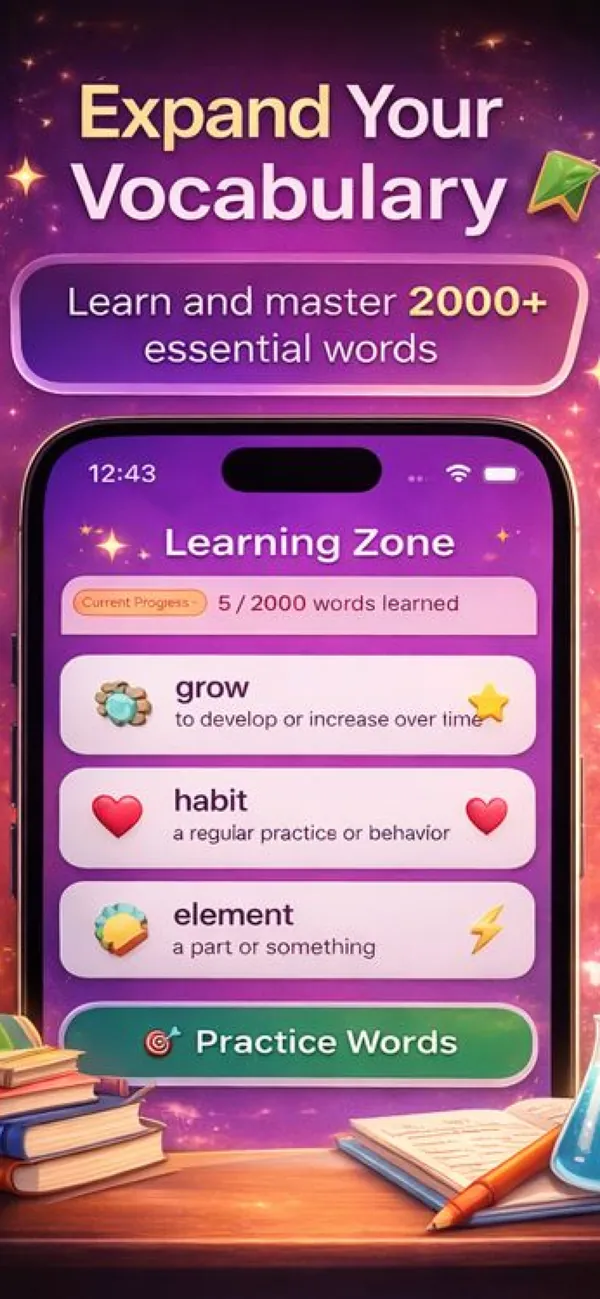
- 11+ Vocab Master, our 11+ vocabulary app: 2,500+ words for CEM-style and GL Assessment tests across 100 categories, 12,000+ vocabulary questions, 6 practice modes, 7 games and unlimited mock tests.
- 11+ Verbal Reasoning Master: 2,000+ verbal reasoning questions covering 38+ question types, with flashcards, mock tests and 5 VR games, such as Analogy Arena and Code Cracker.
- Vocab Master has progress tracking, works offline, is ad-free and has audio pronunciation. VR Master has a Hard Questions list. 11+ Vocab Master is Educational App Store Certified.
Both apps come with a 7-day free trial. After that, 11+ Vocab Master is £3.99 a month, £9.99 for 6 months or £12.99 a year, and 11+ Verbal Reasoning Master is £3.99 a month, £9.99 for 6 months or £14.99 a year.
11+ Vocab Master
11+ Verbal Reasoning Master
Year 5 reading list FAQs
What books should a Year 5 child read?
A wide mix works best: everyday stories, mystery, adventure, fantasy, classics, true stories, graphic novels, non-fiction and poetry. Let your child choose most books for pleasure and add one classic or stretch book at a time. Our list has 43 books for 9- and 10-year-olds, each checked on BookTrust.
Why is reading so important in Year 5 for the 11+?
In areas such as Buckinghamshire and Medway, the 11+ is sat in September of Year 6, so Year 5 is the main year for building vocabulary. 11+ English and verbal reasoning tests rely on a wide vocabulary, and regular reading is one of the best ways to grow it.
Should Year 5 children read classic books?
Yes, alongside modern books. The national curriculum for Years 5 and 6 includes fiction from our literary heritage, and classics such as The Secret Garden and The Lion, the Witch and the Wardrobe use older, more formal words. Reading them together and talking about new words makes them easier.
What does stretch mean on this list?
Stretch books have a BookTrust reading age of 10 or more, so they may be harder for some Year 5 readers. Your child can read them alone if they are confident, or you can share them aloud and stop to talk about interesting words.
How can my child learn new words from books?
Try a word hunt: note three new words per chapter, guess the meaning, check it in a dictionary and use it in a sentence. Keep the words in a notebook, add a synonym and an opposite, and revisit them with a quick game at the weekend.
Sources and further reading
Checked on 16 October 2026: every title and author is on its BookTrust Bookfinder page. Vocabulary notes are our own.
- Great Books Guide 2026–27: for 10 to 11-year-olds, BookTrust
- Great Books Guide 2026–27: for 8 to 9-year-olds, BookTrust
- Medway Test (11+): test dates, Medway Council, and guide to grammar schools and the Secondary Transfer Test, Buckinghamshire Council
- Bookfinder (classic titles and reading ages), BookTrust
- National curriculum in England: English programmes of study, Department for Education